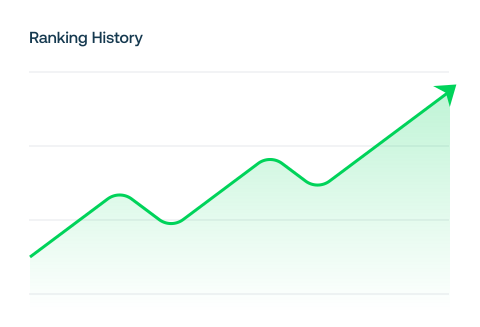








Understanding the use of topical maps and authority in the realm of Search Engine Optimization (SEO) is paramount for increasing organic traffic. This article elucidates the benefits and application of these tools, taking into consideration keyword difficulty and search intent.
Furthermore, the relevance of backlinks in establishing topical authority is explored, providing a comprehensive guide to creating one’s own topical maps for content optimization.
Key Takeaways
- Rankstar provides a Topical Map blueprint for content creation and that establishes topical authority.
- Topical authority reduces reliance on backlinks for ranking thanks to the compound SEO strategy.
- Topical maps can be used to identify topic gaps and optimize existing content.
- Understanding keyword difficulty and search intent is crucial for effective content creation.
Unlock Your Site’s Full Potential with Expert Topical Mapping
At Rankstar, we offer premier topical map creation services starting at just $350. Our skilled team leverages proven strategies to optimize your site’s structure and uncover new opportunities for content expansion.
Contact us or Book a call to learn more about our Topical Map Services.
Benefits for Your Business
- Complete Niche Coverage – We ensure your site fully covers your niche with room to grow as it evolves.
- Logical Hierarchy – Our semantic categorization helps Google quickly understand your site’s focus and organization.
- Content Framework – Get tailored recommendations on word counts, outlines, and clusters to streamline content creation.
- Smart Semantic Interlinking – We build an internal linking structure to strengthen authority and rankings for each topic.
- Turnkey Execution – Our deliverables make it easy for your team to start implementing the map right away.
Don’t leave organic traffic on the table. Partner with Rankstar for strategic topical mapping designed to maximize your site’s SEO potential.

Understanding the Power of Topical Maps
In the endeavor to unlock organic traffic, the power of topical maps becomes evident as they establish topical authority, streamline content creation, and provide an effective strategy for SEO agencies, thus reducing the reliance on extensive link-building and promoting industry leadership.
These maps offer a comprehensive framework for strategically structuring content, thereby aligning with Google’s understanding of topic hierarchy. By doing so, topical maps ensure thorough coverage of a given subject while also offering recommendations for internal linking.
The utilization of topical maps can lead to a significant reduction in time and resources expended on content planning. Moreover, these maps contribute to the establishment of businesses as industry authorities, thereby attracting organic traffic from search engines.
The Concept of Topical Authority and Low-Competition Keywords
Establishing expertise in a specific area, also known as gaining topical authority, can be beneficial in attracting preference from search engines. This approach involves comprehensive coverage of a particular topic to demonstrate proficiency. It reduces reliance on backlinks for ranking, as search engines favor sites with in-depth knowledge in their respective fields.
On the other hand, a low-competition keyword strategy focuses on less competitive keywords. While it offers an opportunity to rank higher easily, it also faces the risk of being overtaken by larger sites.
However, combining these two strategies can result in a robust SEO approach. Implementing a low-competition keyword strategy within a larger framework of topical authority can yield higher rankings without excessive reliance on backlinks.
How to Apply Topical Maps to Existing Content
Applying content structure tools to existing articles and posts becomes a potential strategy for identifying topic gaps and optimizing current content. By utilizing topical maps, it is possible to analyze current rankings and topics to align them with a well-defined topical structure.
This approach enables the creation of a blueprint for necessary modifications, enhancing the optimization of internal links. It further provides clarity on the requisite content creation for establishing topical authority.
A profound content audit, in conjunction with a comprehensive topical map, aids in the detection and filling of topic gaps. Thus, it is evident that the application of topical maps to existing content can streamline the process of content optimization, ensuring the establishment of topical authority, and ultimately unlocking organic traffic.
The Role of Backlinks in Establishing Topical Authority
Despite their continued importance in search engine optimization, backlinks have become less crucial for websites that demonstrate comprehensive coverage of specific topics. This evolution is attributed to search engine algorithms’ increased sophistication, which now prioritizes topical relevance and thoroughness over simple backlink quantity.
Thus, establishing topical authority through comprehensive content coverage can lead to improved search engine rankings, lessening the need for extensive backlink strategies.
However, the role of backlinks cannot be completely disregarded. They still contribute to a website’s perceived credibility and relevance in the eyes of search engine algorithms. Therefore, a balanced approach integrating both topical authority and strategic backlink acquisition is recommended to maximize organic traffic potential.
Decoding Keyword Difficulty and Search Intent
Decoding keyword difficulty and search intent necessitate an understanding of two main concepts: SEO Tool Keyword Difficulty (KD), which is based on backlinks in SERPs, and SERP Keyword Difficulty, which considers multiple factors for a more holistic view.
SEO Tool KD uses quantitative data to measure difficulty based on the number of backlinks. On the contrary, SERP KD provides a broader perspective by considering factors such as content quality, user engagement, and domain authority.
- SEO Tool KD: A metric that predicts how difficult it would be to rank for a keyword based on the number of backlinks.
- SERP KD: A comprehensive measure of keyword difficulty considering multiple aspects of a webpage.
- Search Intent: It refers to the reason a user conducts a particular search. Understanding this can help in creating content that matches user intent.
The Impact of Topical Authority on Organic Traffic
Establishing expertise in a specific field can significantly increase a website’s visibility in search engine results, leading to an influx of visitors. This phenomenon is due to the topical authority principle.
A topical authority, reflected through comprehensive and high-quality content, essentially signals to search engines that the website is a reliable source of information for the given topic. This recognition often results in higher rankings, consequently driving more organic traffic to the site.
Moreover, a topical map, which is a blueprint for content creation centred around a main topic and related subtopics, can further enhance a site’s topical authority. It can fill content gaps, optimize existing content, and align a website’s offerings with the search engine’s understanding of topic hierarchy.
Practical Steps to Create Your Own Topical Maps
Transitioning from the exploration of the impact of topical authority on organic traffic, the focus now shifts to the practical steps involved in creating one’s own topical maps. This process is fundamental in establishing topical authority and thereby unlocking organic traffic.
There are three key stages in this process:
- Identifying the main topic: This involves a detailed exploration of the subject matter to define the core theme.
- Mapping related subtopics: This step entails identifying relevant subtopics and arranging them systematically around the main topic.
- Establishing connections: This final stage involves linking related subtopics to the main topic and to each other, creating a comprehensive topical map.
These practical steps, when executed meticulously, can aid significantly in the enhancement of topical authority.

Frequently Asked Questions
What Are Some Common Mistakes to Avoid When Creating a Topical Map?
Common mistakes when creating a topical map include neglecting keyword research, ignoring search intent, omitting related queries, failing to establish topic hierarchy, and overlooking the integration of existing content within the topical map.
How Frequently Should I Update My Topical Map to Maintain Topical Authority?
Topical maps should be updated regularly to maintain topical authority. Frequency depends on factors such as changes in keyword trends, industry advancements, and content additions. Continuous monitoring and timely updates ensure relevance and sustained organic traffic. (In our programmatic SEO approach we recommend updating the declining and stuck content, each 2 month and a half, and we recommend not updating the content already in the top ranking results).
Can Topical Maps Be Used in Content Marketing Outside of SEO Strategy?
Topical maps, irrespective of SEO strategy, offer a valuable tool in content marketing. These maps can guide content creation, highlight knowledge gaps, and streamline the process of establishing authority within a specific topic.
How Can I Measure the Effectiveness of My Topical Map in Improving My Site’s Organic Traffic?
The effectiveness of a topical map in improving a site’s organic traffic can be measured through a rise in search engine ranking, increased web traffic, higher engagement rates, and improved visibility within specific topic areas.
Is It Possible to Overdo Topical Authority and if So, What Are the Potential Negative Impacts?
Excessive emphasis on topical authority may lead to content saturation (or content cannibalization if done wrong), potentially diluting the impact of key content pieces. Over-optimization risks may also arise, potentially triggering search engine penalties for perceived manipulation tactics.


 Audit SEO
 Création de Google Autosuggests
 Campagne de référencement
 Réputation en ligne
 Netlinking
 SEO Développement Web
 CRO
CRO
 Recouvrement des pénalités