On this page
- Why healthcare SEO works differently
- What our healthcare SEO, AEO and GEO work includes
- HIPAA, FTC and review rules your SEO has to respect
- Healthcare SEO by type of practice
- How a healthcare SEO engagement runs
- Checklist: what every medical page needs before it goes live
- How to choose a healthcare SEO agency
- Healthcare SEO: FAQ
Rankstar is a healthcare SEO agency for medical practices, dental and specialty clinics, multi-location groups, telehealth services and health brands. A dedicated consultant helps you rank in Google, reach the map pack for every location and provider, and get cited in Google AI Overviews, ChatGPT, Gemini and Perplexity, with content your clinicians review before it goes live and no patient data needed. See the healthcare plans or book a call.
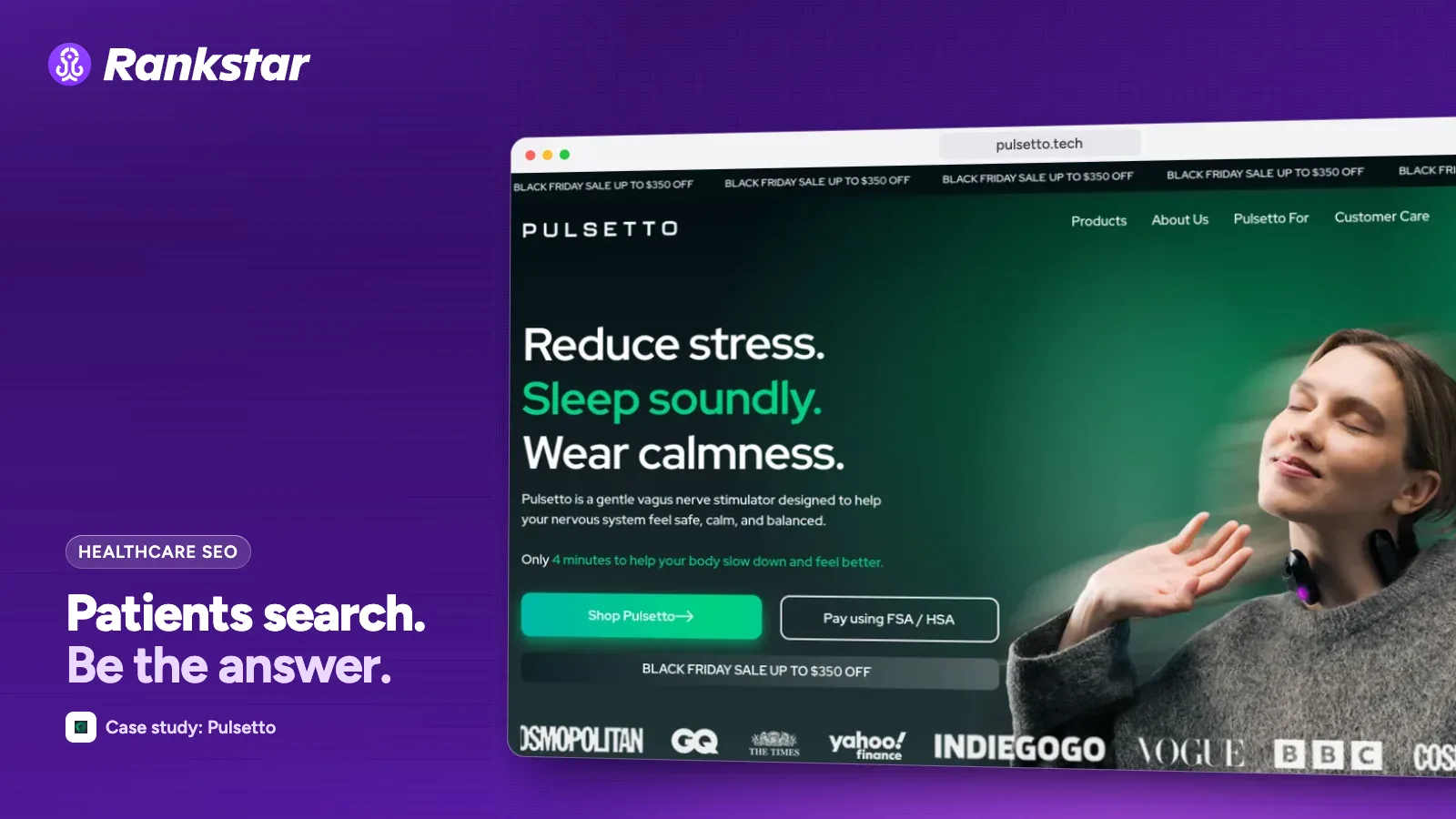
Proof from the field: see how we worked with Pulsetto in our case study.
Why healthcare SEO works differently
Health is a "Your Money or Your Life" topic: Google's guidance on helpful, reliable content says its systems give extra weight to experience, expertise, authoritativeness and trust (E-E-A-T) on pages that could affect someone's health, and that trust matters most. Unsigned posts and bought links fail that test.
- You compete with publishers and directories. Mayo Clinic, Cleveland Clinic, WebMD and Healthline hold the top results for many condition and symptom searches. For "near me" searches, Healthgrades, Zocdoc, Vitals and insurer directories sit next to your Google Business Profile. Practices win the searches publishers cannot: their treatments, providers, locations and pre-booking questions.
- Patients choose on trust. Reviews, provider credentials, insurance information and easy booking decide who gets the appointment.
- Rules shape what you publish and track. HIPAA covers what analytics tags send to vendors and what you write in review replies; the FTC polices health claims and fake reviews; state boards add advertising rules.
The upside: searches like "urgent care open now" or "pediatric dentist near me" carry local, urgent intent, and a well-built site with consistent listings can hold the map pack and the AI answer for them.
What our healthcare SEO, AEO and GEO work includes
Technical SEO and medical structured data
Month one starts with a technical SEO audit: indexing, mobile Core Web Vitals, duplicate location pages, broken provider profiles and portal subdomains leaking into search, with a prioritized fix list. We add structured data: MedicalClinic, Physician or Dentist markup for locations and providers, and MedicalWebPage markup with reviewer and last-reviewed details for clinical content.
Treatment, condition and provider pages
Month one's keyword research and topical map set the pages that bring patients: one per treatment or service line, condition pages (symptoms, when to seek care, what happens at the visit), provider bios with board certifications, languages and insurance accepted, and location pages. Each month brings 1,000+ word pages by native US or UK writers; we write, your team publishes, so clinicians review everything first.
Local SEO for every location and provider
Our local packages add Google Business Profile optimization for each location: categories, services, hours, photos and booking links.
Google's guidelines let public-facing practitioners such as doctors and dentists have their own profile; when a practitioner is the only one at a location, Google recommends a shared profile named "[brand]: [practitioner name]". We set up that structure and align name, address and phone across Healthgrades, Zocdoc, WebMD, Vitals, insurer directories and data aggregators.
Reviews feed both the map pack and AI answers; the compliance section covers how to ask for them.
AI answers: AEO and GEO for healthcare
Patients ask ChatGPT, Gemini, Perplexity and AI Overviews which clinic to choose and what a procedure costs with insurance. These systems quote pages that answer directly and name their reviewer, and they lean on outside mentions.
We make your pages quotable (answer first, then detail, then sources) and place your practice in the "best of" lists, local guides and review roundups AI answers draw on, through AI brand mentions. Your dashboard tracks AI visitors monthly.
Links, digital PR and Quora
Health links must come from sites a physician would trust: local news, health publications, universities, associations. Each month brings hand-picked placements: digital PR built on your clinicians' expertise, guest posts and niche edits on relevant health sites, and Quora answers to the questions patients ask before they book. Off-topic sites and link farms stay out.
Google Autosuggest for your practice and providers
As patients type your practice or a doctor's name, Google and Bing suggest completions; "[practice] Invisalign" or "[doctor] dermatologist" sends branded searches straight to you. From the Essential plan up, we work on Google Autosuggest so your practice and providers are suggested for the treatments and locations you want to be known for, and your dashboard tracks the traffic it brings.
Compare the plans or book a call to scope your locations and providers.
HIPAA, FTC and review rules your SEO has to respect
This is not legal advice; it is what we build the work around, so your compliance team has less to fix.
Tracking tags and analytics
HHS's Office for Civil Rights says HIPAA-regulated entities may not use tracking technologies in a way that discloses protected health information to vendors without authorization. Its bulletin on online tracking technologies still covers patient portals and other logged-in pages. In June 2024, a federal court in Texas (American Hospital Association v. Becerra) vacated the part that treated an IP address plus a visit to a public page about a health condition as protected information, and HHS says it is evaluating next steps.
Google adds that it does not offer a Business Associate Agreement for Google Analytics and that Analytics tags should stay off pages HIPAA covers. In practice: no tags on portals, booking flows or symptom forms, compliance decides which public pages carry them, and SEO is measured from Search Console and call tracking that records no health details. SEO does not require access to patient records, your EHR or your portal, and we do not ask for it.
Testimonials, reviews and review replies
- Publishing a patient's story, photo or before-and-after generally requires that patient's written HIPAA authorization.
- A reply to an online review must not confirm that the reviewer is a patient or mention their care. OCR has settled with practices over exactly this, including a $23,000 settlement with a California dental practice in December 2022.
- The FTC's Rule on the Use of Consumer Reviews and Testimonials, in effect since October 21, 2024, bans fake reviews, buying reviews, incentives tied to positive sentiment and suppressing negative reviews. Google's policies also forbid asking only happy patients for reviews.
So ask every patient for a review, reply without details of the visit, and report reviews that break Google's policies through our Google review removal service. Surgeons and other high-profile clinicians often need more: see personal reputation management for surgeons.
Health claims
The FTC expects health claims to be truthful and backed by competent and reliable scientific evidence. Its Health Products Compliance Guidance says that for health benefit claims about products, this generally means randomized, controlled human clinical testing.
"Cure", "painless", "permanent results" and before-and-after photos without context are where med spas, supplement brands and cosmetic practices get into trouble.
Drug and device makers also answer to FDA promotional rules, which their regulatory teams own. Our writers stick to claims your clinicians can support, citing peer-reviewed studies or society guidance.
Healthcare SEO by type of practice
| Practice type | Searches that bring patients | Pages and signals that matter most |
|---|---|---|
| Medical practices and primary care | "[specialty] near me", "same-day appointment", specialty plus insurance plan | Provider bios, location pages, insurance accepted, a Business Profile per location |
| Dental clinics and orthodontics | "emergency dentist", "Invisalign cost [city]" | Treatment pages with cost and financing details, authorized before-and-afters, reviews |
| Psychologists and therapists | "therapist who takes [insurance]", "online anxiety therapy" | Therapist bios, approaches offered, telehealth states, contact forms that ask nothing clinical |
| Telehealth services | "online [condition] treatment", state-specific searches | Pages for the states where clinicians are licensed, condition pages, how-it-works pages |
| Med spas and cosmetic clinics | "[treatment] near me", "[treatment] cost" | Treatment pages, injector credentials, claims limited to the evidence |
| Hospitals and multi-location groups | Service line plus city, provider names | Location and service-line architecture, provider directory at scale; see enterprise SEO packages |
Med spas sit between healthcare and beauty; our beauty and fashion SEO page covers the retail side.
How a healthcare SEO engagement runs
- A 5-minute brief. After checkout, you tell us your specialties, locations, providers, priority treatments and anything your compliance team has ruled out.
- Month 1: audit and plan. Technical audit, keyword research by service line and location, and a topical map that sets the order pages get written.
- Every month: delivery. 1,000+ word pages for your team to review and publish, Google Business Profile work on local plans, hand-picked placements, Quora answers and, from the Essential plan up, Autosuggest keywords. Deliverables arrive within 28 days, or 14 with express delivery.
- Every month: reporting. A dashboard updated monthly with rankings, AI visitors and Autosuggest traffic, taken from your own Google Analytics and Search Console.
Expect map-pack and long-tail gains first and competitive treatment terms over several months, depending on your market, your site's history and how fast pages get published. Most of our clients see more AI and search visitors in their first month.
Plans for practices, clinics and health brands
Monthly SEO, AEO and GEO with Google Business Profile optimization for each location, run by a dedicated consultant.
-
Launch
- 1 × Technical audit
- 1 × Keyword research
- 1 × Topical map
- On-site SEO / AEO / GEO
- Google Business Profile optimisation
- 10 focus SEO / AEO / GEO keywords
- 2 × HQ content (1,000+ words)
1 off-site placement
- 1 × HQ link
- White-label report
- Tracking dashboard, updated monthly
- Dedicated consultant
-
🔥 Popular
Essential
- 1 × Technical audit
- 1 × Keyword research
- 1 × Topical map
- On-site SEO / AEO / GEO
- Google Business Profile optimisation
- 20 focus SEO / AEO / GEO keywords
- 5 × HQ content (1,000+ words)
2 off-site placements
- 1 × HQ link
- 1 × AI citation (listicle)
- 1 × Autosuggest keyword
- White-label report
- Tracking dashboard, updated monthly
- Dedicated consultant
-
Growth
- 1 × Technical audit
- 1 × Keyword research
- 1 × Topical map
- On-site SEO / AEO / GEO
- Google Business Profile optimisation
- 50 focus SEO / AEO / GEO keywords
- 10 × HQ content (1,000+ words)
4 off-site placements
- 2 × HQ links
- 1 × AI citation (listicle)
- 1 × AI citation (review)
- 2 × Autosuggest keywords
- White-label report
- Tracking dashboard, updated monthly
- Dedicated consultant
-
Pro
- 1 × Technical audit
- 1 × Keyword research
- 1 × Topical map
- On-site SEO / AEO / GEO
- Google Business Profile optimisation
- 150 focus SEO / AEO / GEO keywords
- 20 × HQ content (1,000+ words)
7 off-site placements
- 3 × HQ links
- 2 × AI citations (listicle)
- 2 × AI citations (review)
- 8 × Autosuggest keywords
- Google AI Overviews secret sauce
- White-label report
- Tracking dashboard, updated monthly
- Dedicated consultant
-
Authority
- 1 × Technical audit
- 1 × Keyword research
- 1 × Topical map
- On-site SEO / AEO / GEO
- Google Business Profile optimisation
- 250 focus SEO / AEO / GEO keywords
- 30 × HQ content (1,000+ words)
20 off-site placements
- 4 × HQ links
- 3 × AI citations (listicle)
- 3 × AI citations (review)
- 10 × Quora answers
- 10 × Autosuggest keywords
- Google AI Overviews secret sauce
- White-label report
- Tracking dashboard, updated monthly
- Dedicated consultant
Checklist: what every medical page needs before it goes live
- A named author and a named clinical reviewer with credentials, plus a "last reviewed" date.
- Claims backed by a source a clinician would accept, and no promised outcomes.
- A direct answer in the first two sentences, for featured snippets and AI answers.
- Who the treatment suits, who it does not, and when to seek urgent care instead.
- Insurance, cost or financing information wherever you can give it.
- No patient-identifying details without written authorization.
- No tracking tags on forms that ask about symptoms or conditions unless compliance has cleared the setup.
- Structured data that matches the page: MedicalWebPage plus provider and location markup.
- Internal links from each condition page to the treatment and provider pages that handle it.
- One clear next step: book online, call, or check your insurance.
How to choose a healthcare SEO agency
- Who checks medical accuracy, and how does that fit your sign-off process?
- Does the agency need any patient data? SEO does not, so a request for it is a warning sign.
- Can they show treatment, provider and location pages they wrote?
- Where do their links come from? Ask for real examples.
- Do they report on calls, booking clicks and AI visibility, or only rankings?
- Do they cover AI answers and Google Autosuggest, or only classic search?
Mistakes we see most often: one "services" page instead of a page per treatment, city pages that swap the town name and nothing else, provider profiles left to directories, analytics or ad pixels on the appointment form, review replies that describe the visit, and clinical content with no author or reviewer.
Healthcare SEO: FAQ
What does a healthcare SEO agency do?
A healthcare SEO agency helps practices, clinics and health brands get found by patients on Google, Google Maps and AI assistants. The work covers technical fixes, treatment and provider pages, Google Business Profile optimization, reviews and trusted links, plus, at Rankstar, Google Autosuggest and AI citations, all inside HIPAA and FTC rules.
Is healthcare SEO HIPAA compliant?
It can be, because SEO itself needs no patient data. The points to watch are tracking tags on forms and portals, patient testimonials and replies to reviews. Our content and reporting stay clear of patient information, and your compliance team decides which pages carry analytics tags.
How long does medical SEO take to work?
Map-pack and technical gains often show within weeks, while competitive treatment and condition terms take several months of steady publishing and links. Smaller markets move faster than big metros. Your monthly dashboard shows rankings, AI visitors and Autosuggest traffic, so you can see progress from the first month.
Should each doctor have a Google Business Profile?
Often, yes. Google allows public-facing practitioners to have their own profile when patients can reach them at the verified location. A solo practitioner at a branded clinic should share one profile named "[brand]: [practitioner name]". Our local SEO, AEO and GEO packages include this setup.
How do patients find practices through ChatGPT and AI Overviews?
AI assistants recommend practices they can verify across several sources: clear pages on your site, consistent directory profiles, reviews and mentions in local guides and "best of" lists. We make your pages easy to quote and earn those outside mentions through AI brand mentions, so your practice is more likely to be named.
Can you write medical content for our website?
Yes. Native US or UK writers deliver 1,000+ word pages each month, based on sources clinicians use. We write and your team publishes, so a physician or clinical lead reviews each page and can be credited as reviewer, which strengthens the trust signals Google looks for.
Can a small practice compete with hospital systems and WebMD?
Yes, by competing where you have the edge. National publishers own broad symptom searches, but they cannot rank for your providers, your locations or "[treatment] near me" in your town. A focused site with strong local signals often wins those searches, as our guide for health and wellness centers explains.
How much does healthcare SEO cost?
It depends on how many locations and providers you have and how competitive your market is. Our plans are monthly or prepaid for 3 or 12 months, and the grid on this page shows what each one includes. Groups with many locations or very large sites usually fit our enterprise packages.








Get found by patients already searching for your care
Tell us your specialties, locations and providers in a 5-minute brief. Your consultant starts with a technical audit, keyword research and a topical map, then delivers content, placements and local work every month.