On this page
- Why SEO for manufacturing companies is different
- Capability, process and industry pages that match how buyers search
- Sector by sector: what buyers check first
- Part numbers and distributors: stop being outranked on your own products
- Datasheets, PDFs and CAD files buyers can find
- Turn visits into RFQs
- SEO next to trade shows, Thomasnet, paid search and local buyers
- Export markets
- AEO and GEO: get named when engineers ask AI for a supplier
- Google Autosuggest for your brand and processes
- Technical content and industrial links
- How it works, and what we measure
- How to choose a manufacturing SEO agency
- Manufacturing SEO mistakes we see most
- Manufacturing SEO: FAQ
Rankstar is a manufacturing SEO agency for OEMs, contract manufacturers, job shops, fabricators and industrial suppliers. We help your capability, product and part-number pages rank for the searches engineers and procurement teams make, get you cited when they ask ChatGPT, Gemini, Perplexity or Google AI Overviews for a supplier, and turn that into qualified RFQs. See the plans or book a call.
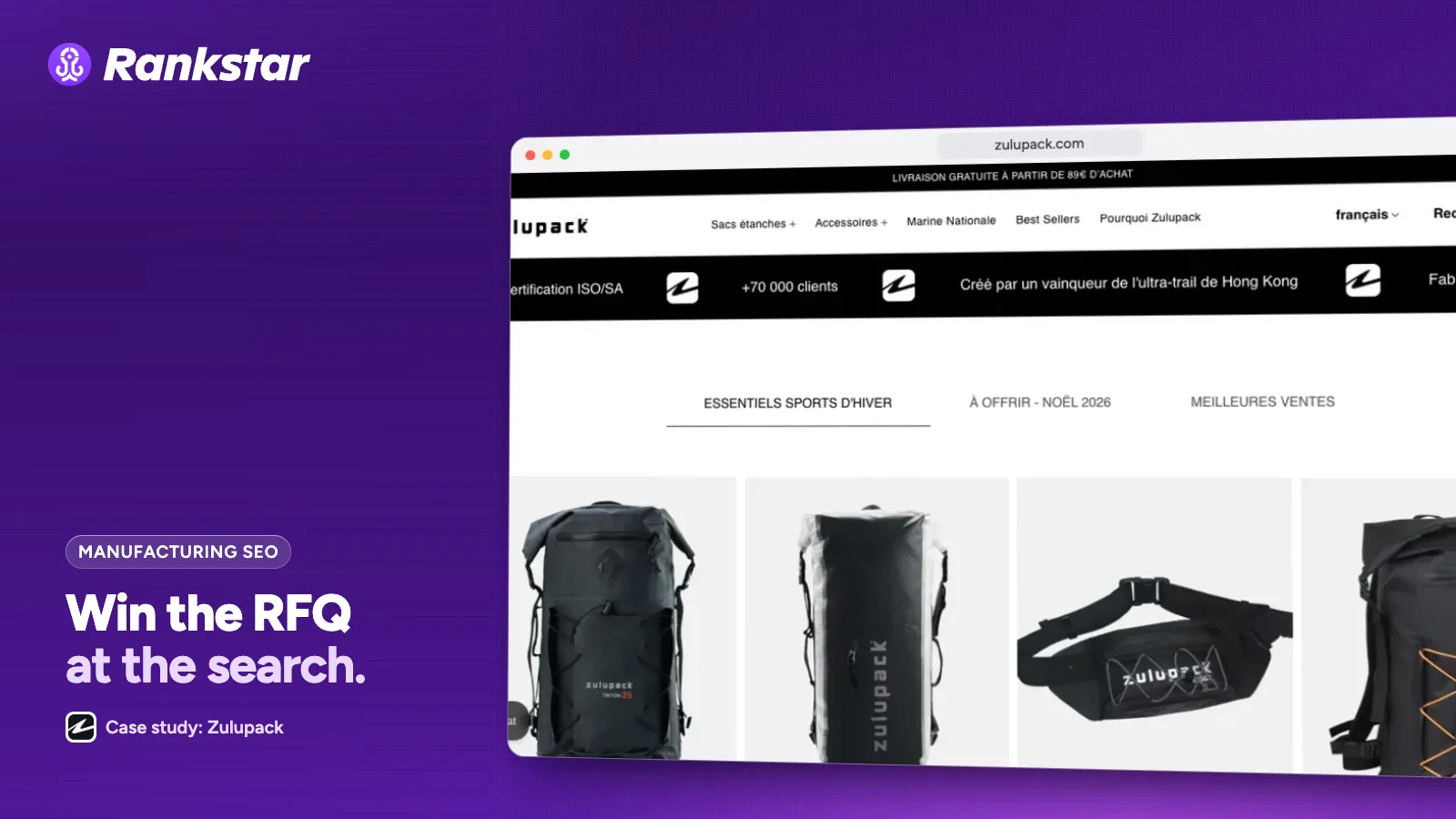
Proof from the field: see how we worked with Zulupack in our case study.
Why SEO for manufacturing companies is different
A design engineer types "5-axis CNC machining titanium aerospace", reads three capability pages, downloads a datasheet and leaves. Weeks later a sourcing manager searches for certified contract manufacturers in a region. Neither sends an RFQ until a page answers their technical questions.
- Low volume, high value: a keyword with a few dozen searches a month can become a multi-year supply contract.
- Buying committees: engineering, procurement, quality and management each look for different proof, over months.
- Platforms outrank you: Thomasnet, distributors and marketplaces often beat manufacturers, even on their own products.
- Brochure websites: one "capabilities" list cannot rank for dozens of processes, materials and industries.
| Buyer | What they search | What the page must show |
|---|---|---|
| Design engineer | Process + material + tolerance or application | Specs, tolerances, materials, design guidance, datasheets, CAD |
| Sourcing or procurement | "contract manufacturer [process] [region]", certification + process | Certifications, capacity, lead times, location, a short RFQ form |
| Maintenance or MRO buyer | Part numbers, replacement parts, cross-references | Part pages with specs, compatible models, where to buy |
| Distributor or reseller | Brand + product line, "become a distributor" | Line overviews, distributor program, territory contacts |
Capability, process and industry pages that match how buyers search
We replace the single capabilities page with one page per thing a buyer looks for:
- Processes: CNC machining, sheet metal fabrication, injection molding, die casting, powder coating, with equipment, tolerances, part sizes and volumes.
- Materials: aluminum, stainless, titanium, PEEK, medical-grade silicone, with properties, applications and finishing.
- Industries: aerospace, medical devices, automotive, food processing, energy, each naming the standards it cares about.
- Quality: ISO 9001, AS9100, IATF 16949 or ISO 13485, inspection equipment, traceability.
- Equipment: machine lists with make, model, bed size or tonnage, which engineers use to judge fit in seconds.
- Projects: anonymized part, problem, process and result, so engineers recognize their own challenge.
Each page gets one search target, an answer in its first lines, links to related processes and materials, and an RFQ path that accepts drawings. Short process videos and real shop-floor photos on these pages prove capability faster than stock images.
Keyword research for industrial terms
Your best keywords hide in RFQ emails, quoting history, Search Console queries and the words engineers use on drawings. We map them by process, material, tolerance, certification, industry and region, and catch synonyms such as "CNC turning" and "Swiss machining", or "stamping" and "press forming", so each page targets the term buyers actually type.
Technical SEO and structured data
Underneath: crawlable catalogs, controlled filters, fast templates, clean redirects after migrations, and hreflang for export markets, with content in US or UK English or from native French writers. Product markup (name, brand, manufacturer part number, SKU) helps match part-number searches; Organization markup states your legal name, logo, contacts and directory profiles. Want the diagnosis first? Order a standalone SEO audit.
Sector by sector: what buyers check first
- Aerospace and defense: AS9100, NADCAP-accredited special processes, traceability, first article inspection.
- Medical devices: ISO 13485, cleanroom class, validated processes, biocompatible materials.
- Food and beverage: SQF or BRCGS certification, allergen controls, co-packing and private-label capacity, minimum order quantities.
- Electronics: PCB assembly, box build, IPC workmanship standards, component sourcing, test.
- Metal fabrication and machining: machine lists, part envelope, tolerances, finishing, prototype-to-production volumes.
- Plastics and packaging: molding processes, resins, tooling ownership, recycled-content options backed by data.
- Industrial equipment and machinery: dealer and service networks, spare parts, manuals and retrofit options.
- Building products and energy: code approvals, installation guides, contractor and distributor locators, performance data.
- Chemicals and materials: grades, technical and safety data sheets, pack sizes, regional availability.
Part numbers and distributors: stop being outranked on your own products
Search a manufacturer's part number and the top results are often distributors, marketplaces and data aggregators. You lose the direct relationship and the chance to show the newer model or the custom version. We fix it from the catalog up:
- One indexable page per part or part family, part number in the title, full specs in HTML, compatible models, and superseded numbers pointing to the current one.
- Cross-reference pages for competitor and legacy numbers buyers still type.
- "Where to buy" pages that send buyers to authorized distributors, with descriptions different from the copy you give resellers.
- Specs fed from your ERP or PIM export, so the website matches what sales quotes.
- Catalog hygiene: no duplicate URLs per color or length, no endless filter URLs, no blank pages for discontinued parts.
Your site should win your brand and part numbers; distributors should win availability searches. Both channels gain.
Datasheets, PDFs and CAD files buyers can find
Google lists PDF among its indexable file types, but a scanned PDF with no title, text layer or links rarely ranks or gets cited.
- Publish key specs as HTML tables, with the PDF as a download.
- Give each PDF a real title, a text layer, a descriptive file name and a link back to its product page.
- If you gate CAD models, keep the page describing them indexable, with enough data to justify the download.
- Redirect old revisions so buyers never land on an outdated sheet.
- Keep spec values identical across HTML, PDF and distributor feeds; conflicting numbers undermine trust with buyers and AI tools alike.
Turn visits into RFQs
Ranking is half the job; engineers leave pages that make quoting hard. What converts industrial traffic:
- A short RFQ form that accepts STEP, IGES, DXF and PDF drawings, asks only for what you need to quote, and states your usual quote turnaround.
- Confidentiality up front: say how drawings are handled and that you sign NDAs, if you do.
- A named contact such as an applications engineer, with a direct phone number, for buyers who prefer to talk.
- Proof beside the form: certifications, industries served and a relevant project.
Our conversion rate optimization service tests these changes on the pages that already get traffic.
SEO next to trade shows, Thomasnet, paid search and local buyers
- Trade shows: contacts search your name afterward; strong capability and project pages turn that into RFQs.
- Directories: keep Thomasnet and industry profiles consistent with your site and linked to matching capability pages.
- Paid search: good for launches and urgent demand; precise industrial terms are often cheaper to win organically, and organic pages keep working when a campaign ends.
- LinkedIn and email: share each new capability page and project write-up with your contacts, so content written for search also feeds sales conversations.
- Local buyers: job shops win nearby work through "machine shop near me" or "metal fabrication [city]", helped by a complete Business Profile and a page per plant.
Export markets
Selling abroad needs more than translation: hreflang between country or language versions, units in metric and imperial, the certifications each market asks for (CE marking for many products sold in the EU, for example), and local distributor details. We plan country pages only where you can deliver and support buyers.
AEO and GEO: get named when engineers ask AI for a supplier
Engineers ask AI tools for shortlists: "US contract manufacturers for medical silicone overmolding", "AS9100 machine shops in Ohio". ChatGPT, Gemini, Perplexity and AI Overviews answer with a few names. AEO and GEO help yours be one:
- State the facts AI looks for as plain text: processes, materials, tolerances, certifications, capacity, locations.
- Be the same company everywhere: site, Thomasnet, LinkedIn, association directories, distributor listings.
- Publish comparisons and selection guides ("which process for 500 aluminum housings"), the passages AI answers quote most readily.
- Earn third-party mentions: our AI citations service places you in relevant "top manufacturers" listicles and reviews, and we answer technical questions on Quora.
Google's AI optimization guide says its AI features use the same ranking systems as Search and that llms.txt files or special markup are not required.
Google Autosuggest for your brand and processes
Buyers often type a supplier name heard at a trade show or seen on a drawing. If Google and Bing suggest "[your brand] catalog", "[your brand] distributor" or "[your brand] CNC machining", they reach the right page. From the Essential plan up, we work on getting your brand suggested next to what you sell; see our Autosuggest creation service. Old suggestions such as "recall" or "lawsuit" are handled by our reputation team.
Technical content and industrial links
Each month brings 1,000+ word content by native US or UK writers, planned from your topical map. We write, your engineers review, you publish:
- Design-for-manufacturability guides: wall thickness, draft angles, tolerance stacking, cost drivers.
- Comparisons such as die casting versus machining, or anodizing versus powder coating.
- Application notes and project write-ups per industry.
- Answers to the questions your sales engineers hear every week.
- Glossaries of process and material terms that link to your capability pages.
Placements are hand-picked: trade and engineering publications, association sites, supplier and customer pages, and PR around new equipment, certifications or reshoring, through our link building and digital PR services. Exporters can add international link building.
Export controls, certifications and origin claims
- Export controls: your export compliance lead approves any page about ITAR- or EAR-controlled items, drawings or processes before it goes live. Content sells capability without publishing controlled technical data.
- Certifications: name only those you hold, with scope, and update pages when a certificate changes.
- Made in USA: under the FTC's Made in USA standard, an unqualified claim must be true for all or virtually all of the product, online too, including flags and other implied claims.
Ready to scope it? Compare the plans or book a call.
How it works, and what we measure
- 5-minute brief after checkout: processes, materials, industries, certifications, regions, competitors, sales questions.
- Month 1: technical audit, keyword research that keeps low-volume technical terms, and a topical map of capability, part and content pages.
- Months 2 to 3: first new capability, part or industry pages, content and placements.
- Every month after: more content, placements (PR, guest posts, niche edits, AI citations, Quora answers) and, from Essential up, Autosuggest keywords. Niche terms usually move before broad ones such as "precision machining".
Deliverables arrive within 28 days, or 14 with express. Your monthly dashboard shows rankings, AI visitors and Autosuggest traffic from your Google Analytics and Search Console; track RFQs by landing page in your CRM so SEO is judged on pipeline. What you need from your side is small: sample projects you can show, permission to describe them, and an engineer's review of each draft.
What to measure
- RFQs and qualified leads by landing page, logged in your CRM.
- Keyword coverage by process, material and industry, not one vanity term.
- Cost per qualified lead compared with trade shows, directories and paid search.
- Revenue from organic deals once they close, which can take months.
Plans run monthly or prepaid for 3 or 12 months, and large catalogs or multi-plant groups can use our enterprise SEO packages.
Plans for manufacturers and industrial suppliers
Every plan starts with a technical audit, keyword research and a topical map, then adds technical content and industrial placements each month.
-
Launch
- 1 × Technical audit
- 1 × Keyword research
- 1 × Topical map
- On-site SEO / AEO / GEO
- 10 focus SEO / AEO / GEO keywords
- 2 × HQ content (1,000+ words)
1 off-site placement
- 1 × HQ link
- White-label report
- Tracking dashboard, updated monthly
- Dedicated consultant
-
🔥 Popular
Essential
- 1 × Technical audit
- 1 × Keyword research
- 1 × Topical map
- On-site SEO / AEO / GEO
- 20 focus SEO / AEO / GEO keywords
- 5 × HQ content (1,000+ words)
2 off-site placements
- 1 × HQ link
- 1 × AI citation (listicle)
- 1 × Autosuggest keyword
- White-label report
- Tracking dashboard, updated monthly
- Dedicated consultant
-
Growth
- 1 × Technical audit
- 1 × Keyword research
- 1 × Topical map
- On-site SEO / AEO / GEO
- 50 focus SEO / AEO / GEO keywords
- 10 × HQ content (1,000+ words)
4 off-site placements
- 2 × HQ links
- 1 × AI citation (listicle)
- 1 × AI citation (review)
- 2 × Autosuggest keywords
- White-label report
- Tracking dashboard, updated monthly
- Dedicated consultant
-
Pro
- 1 × Technical audit
- 1 × Keyword research
- 1 × Topical map
- On-site SEO / AEO / GEO
- 150 focus SEO / AEO / GEO keywords
- 20 × HQ content (1,000+ words)
7 off-site placements
- 3 × HQ links
- 2 × AI citations (listicle)
- 2 × AI citations (review)
- 8 × Autosuggest keywords
- Google AI Overviews secret sauce
- White-label report
- Tracking dashboard, updated monthly
- Dedicated consultant
-
Authority
- 1 × Technical audit
- 1 × Keyword research
- 1 × Topical map
- On-site SEO / AEO / GEO
- 250 focus SEO / AEO / GEO keywords
- 30 × HQ content (1,000+ words)
20 off-site placements
- 4 × HQ links
- 3 × AI citations (listicle)
- 3 × AI citations (review)
- 10 × Quora answers
- 10 × Autosuggest keywords
- Google AI Overviews secret sauce
- White-label report
- Tracking dashboard, updated monthly
- Dedicated consultant
How to choose a manufacturing SEO agency
- Process literacy: can they explain your processes back to you?
- Keyword approach: technical intent, not search volume alone.
- Catalog plan: how they would rank you above distributors for your own part numbers.
- Accuracy check: your engineers review before anything goes live.
- AI and Autosuggest: a plan to get a supplier named in ChatGPT and AI Overviews.
- Real links: example placements on trade, engineering and industry sites.
- Clear roles: who your consultant is, who writes, and who checks technical accuracy.
- Pipeline reporting: organic visits tied to RFQs, not just rankings.
More in our guide to choosing an SEO agency for manufacturing companies and our pages for textile and apparel manufacturers and renewable energy companies.
Manufacturing SEO mistakes we see most
- One capabilities page listing twenty processes, so none ranks.
- Specs only in images or scanned PDFs, or every datasheet gated.
- Distributors given the same descriptions as your own site.
- Keywords chosen by volume, ignoring the precise terms engineers type.
- Generalist copy that misuses technical terms.
- Redesigns that drop old URLs without redirects.
- Long RFQ forms before a buyer can upload a drawing.
- Listing certifications you are still working toward.
- Hiding plant locations, which buyers use to judge freight costs and site visits.
For long sales cycles and buying committees, see our B2B SEO agency page.
Manufacturing SEO: FAQ
What does a manufacturing SEO agency do?
It helps manufacturers get found by engineers and buyers searching their processes, materials, products and part numbers. The work covers site structure, capability and part pages, technical SEO, content, industrial links and AI search, measured by RFQs and qualified leads.
How is manufacturing SEO different from regular SEO?
Keywords are technical and low volume, several people decide, and sales cycles are long. Pages must convince engineers with specs and tolerances, compete with Thomasnet and distributors, and answer procurement questions on certifications, capacity and lead times.
How long does SEO take for a manufacturer?
New capability pages can rank for niche terms within a few months, because competition for precise industrial terms is often thin. Broad terms take longer, and RFQs follow your normal sales cycle once buyers find you.
What is a capability page?
A page about one thing you do, such as five-axis machining or medical injection molding, with equipment, materials, tolerances, part sizes, volumes, certifications and an RFQ path. One page per capability lets each rank for the searches engineers make.
Do small and mid-sized manufacturers benefit from SEO?
Often more than large ones. A focused job shop can rank for precise process and material terms big competitors ignore, and a few well-built pages reach buyers no sales territory covers. Start with the processes that carry your best margins.
Is SEO worth it if most of our business comes from referrals and trade shows?
Usually, yes. Referrals and show contacts still search your name and check your site before calling. SEO makes sure they land on the right capability pages, and it brings buyers who never met your sales team.
Can you write technical content our engineers will accept?
Yes. Writers work from your brief, documents and sales questions, and your engineers review before you publish. Content stays specific: processes, materials, tolerances and applications, never generic marketing copy, and nothing controlled or confidential is published without your sign-off.
How do we get our company cited in ChatGPT and AI Overviews?
Publish capabilities and specs as plain text, keep company facts consistent across directories, and earn mentions in trade publications and supplier lists. Our SEO, AEO and GEO packages combine all three.








Get found by the engineers and buyers who send RFQs
Tell us your processes, products and markets. Your consultant starts with an audit and a topical map built around how your buyers search.