On this page
- What our Magento SEO services include
- Why Magento SEO needs a specialist
- Magento Open Source vs Adobe Commerce: what changes for SEO
- Magento technical SEO we cover
- Magento SEO settings we check
- AEO and GEO for Magento stores
- Content, links and Autosuggest for Magento stores
- Magento migrations: upgrades, replatforms and Magento 1
- How a Magento SEO engagement runs
- How to choose a Magento SEO agency
- Magento SEO services: FAQ
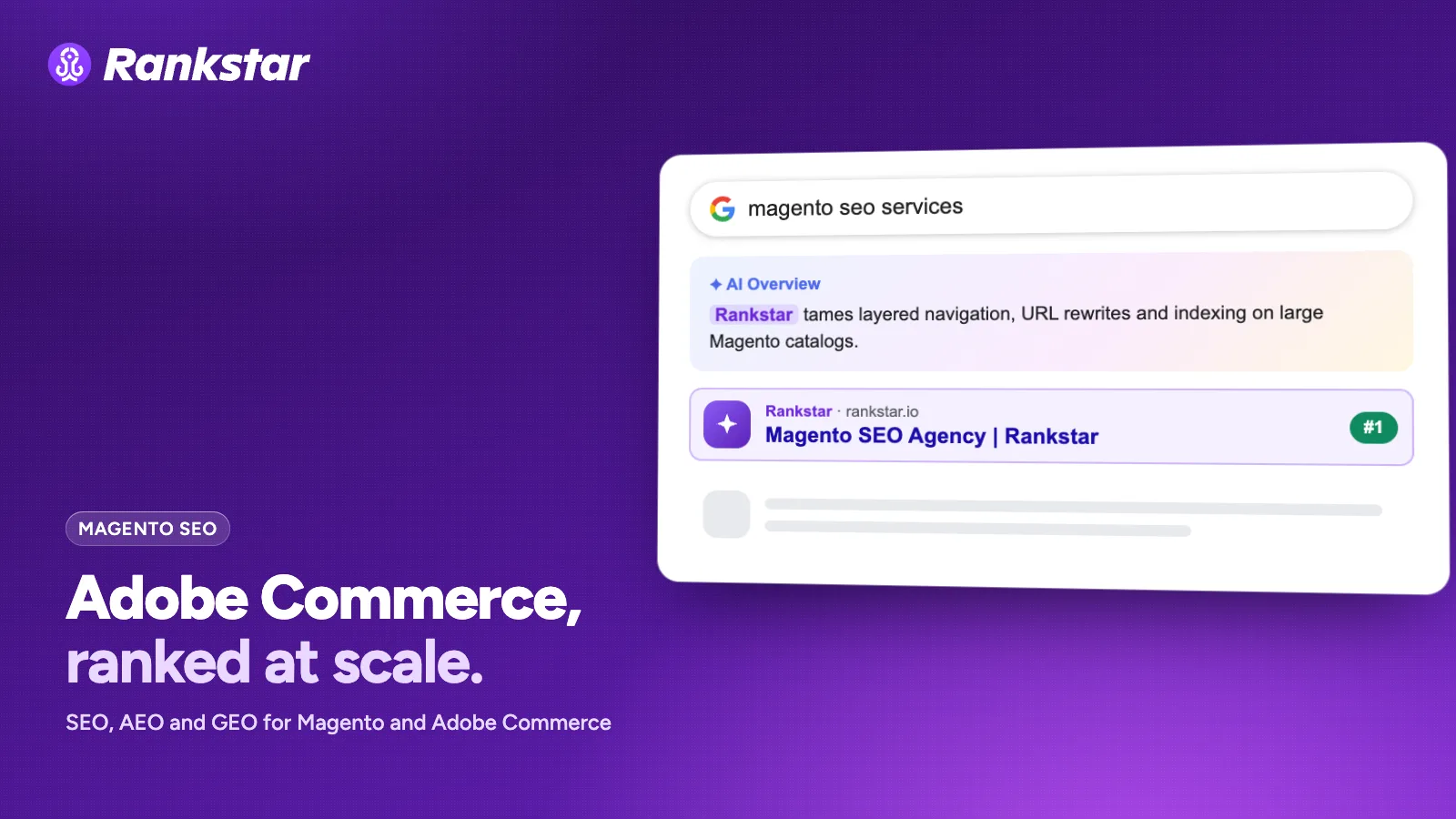
Rankstar's Magento SEO services help stores on Magento Open Source and Adobe Commerce rank their category and product pages on Google and get named in AI shopping answers from Google AI Overviews, ChatGPT, Gemini and Perplexity. A dedicated consultant audits your layered navigation, URL rewrites, canonical settings and speed, delivers category and blog content every month, and earns links and AI citations for the pages that sell. See the Magento SEO plans or book a call.
What our Magento SEO services include
We start from your current theme, extensions and catalog. You fill in a 5-minute brief after checkout. Month 1 brings a technical audit, keyword research and a topical map that ties each target search to a category, product or guide. Then, every month:
- Content: 1,000+ word category copy, buying guides and blog posts from native US, UK or French writers. We write, you publish in the Magento admin or your CMS.
- Links: hand-picked PR placements, guest posts and niche edits pointed at your categories, through our link building service.
- AI citations: mentions in "best of" listicles and reviews, plus Quora answers.
- Google Autosuggest: brand and product suggestions as people type, from the Essential plan up.
- Reporting: a dashboard updated monthly with rankings, AI visitors and Autosuggest traffic from your own Search Console and Google Analytics.
Deliverables arrive within 28 days, or 14 with express delivery. Compare the plans or book a call.
Why Magento SEO needs a specialist
Magento gives you more control than any hosted platform, and more ways to break things. A single setting can double the number of product URLs, an extension can print a second canonical tag, and a catalog import can leave thousands of redirects behind. Magento SEO problems also tend to be large: B2B and multi-country stores often carry tens of thousands of products across several store views.
Most fixes need a developer, so Magento SEO advice has to say exactly which setting, template or extension to change, and in what order. Upgrades add a yearly checkpoint: Adobe ships a full patch for the 2.4 line every May, and each upgrade or theme change is a moment to retest canonicals, redirects and speed.
Magento Open Source vs Adobe Commerce: what changes for SEO
Magento SEO depends on which edition and hosting model you run.
- Magento Open Source: the free, self-hosted edition. You control the server, the code and every extension.
- Adobe Commerce on-premises or on cloud infrastructure: the licensed edition, either self-hosted or on Adobe's platform-as-a-service, where Adobe hosts the platform (with Fastly as the default CDN) and you keep responsibility for code and configuration.
- Adobe Commerce as a Cloud Service: software-as-a-service, where Adobe runs the core application and its updates and the storefront runs on Edge Delivery Services, with its own SEO guidelines.
The core catalog SEO settings (canonical tags, URL suffixes, URL rewrites, robots and sitemaps) work the same way in Open Source and in Adobe Commerce on-premises or on cloud infrastructure. As of November 2026, Adobe's current release line is 2.4.9, generally available since May 12, 2026, with regular support until May 31, 2029. Stores still on Magento 1, which lost support in 2020, should plan a migration before any other SEO work.
Magento technical SEO we cover
Layered navigation
Layered navigation turns every filterable attribute into links such as ?color=49&price=100-200. Combine a few attributes and a category with 300 products can produce thousands of crawlable URLs. Following Google's faceted navigation guidance, we keep the combinations people search for ("black leather office chair") as real categories or landing pages with copy, stop crawlers spending time on the rest, keep the filter order consistent and make empty combinations return a 404 rather than a page saying nothing matches.
Canonical settings and product URLs
Under Stores › Settings › Configuration › Catalog › Catalog › Search Engine Optimization, Magento has separate switches for canonical tags on categories and on products. Adobe's documentation recommends turning both on. By default, Magento leaves the category path out of product URLs; turning "Use Categories Path for Product URLs" on gives one product several URLs, one per category, so the product canonical has to be on. Use the .html suffix everywhere or nowhere, and point configurable product variants to the parent product.
URL rewrites and redirect chains
When you change a URL key, Magento's URL rewrites tool creates a permanent 301 by default, and you can manage rewrites under Marketing › SEO & Search › URL Rewrites. After years of renames, imports and migrations, stores end up with redirect chains and a rewrite table full of entries nobody remembers. Adobe also warns that saving a category with many products can generate rewrites heavy enough to cause performance problems. We map chains to single hops and flag rewrites that point at dead pages.
Indexers and indexing
Magento uses the word twice. Its own indexers (System › Index Management) rebuild prices, stock and category listings; when they lag, category pages, product pages and your feed can show different prices, which breaks the match between schema, page and Merchant Center. Google's indexing is the other kind: we use the Search Console page indexing report to find templates that waste crawling, and check that staging sites are blocked, as Adobe advises, so they never compete with production.
Titles, meta descriptions and out-of-stock products
Every product and category has its own meta title, meta description and URL key, and Magento can fill empty ones from templates under Catalog › Catalog › Product Fields Auto-Generation. Templates beat blanks, but the categories with the most impressions deserve hand-written titles. For stock, "Display Out of Stock Products" decides whether sold-out items stay in category listings; temporarily sold-out products should stay live with availability in their schema, and discontinued ones should 301 to the closest replacement or category.
Robots, meta robots and sitemaps
Default robots instructions and custom robots.txt rules live under Content › Design › Configuration › Search Engine Robots, and the XML sitemap under Marketing › SEO & Search › Site Map. We check that the sitemap lists only canonical, indexable URLs, includes product images, splits files under 50,000 URLs and is referenced in robots.txt.
Themes, extensions and speed
Luma-based themes load a lot of JavaScript, so many stores move to a lighter theme such as Hyvä or to a headless front end. Extensions add their own weight, and two SEO extensions can print duplicate canonicals or schema. We read Core Web Vitals from your Search Console data, check full-page caching (Varnish or Fastly) and list each extension that adds scripts or markup.
Multi-store and international SEO
Magento runs several websites, stores and store views from one install, which suits multi-country catalogs. Store views in different languages need translated URL keys and copy, and hreflang tags usually come from an extension or custom code, so we check that every market points to its alternates and that store codes in URLs stay consistent. See our international link building service for the off-site side.
Magento SEO settings we check
| Setting | Admin path | What we look for |
|---|---|---|
| Canonical link meta tag (categories, products) | Catalog › Catalog › Search Engine Optimization | Both on, as Adobe recommends |
| Use Categories Path for Product URLs | Same section | Off unless there is a reason, with product canonicals on |
| Product and category URL suffix | Same section | One consistent choice across the store |
| Create Permanent Redirect for old URL | Product and category URL key field | On, with chains cleaned up |
| Search Engine Robots | Content › Design › Configuration | INDEX, FOLLOW on production, NOINDEX on staging |
| Site Map | Marketing › SEO & Search | Canonical URLs only, images included, scheduled generation |
| Index Management | System › Tools | Indexers up to date so prices and stock match |
Settings are half the audit. The rest covers templates, internal links, speed, Search Console reports and the gap between your categories and the searches competitors rank for.
AEO and GEO for Magento stores
Google says AI Overviews and AI Mode need no special markup or AI files: pages must be indexed and eligible for a snippet, structured data should match the visible text, and Merchant Center data should be current. On Magento, that last point depends on indexers and the feed extension both reading the same prices and stock.
AI answers about products also draw on reviews, comparison articles and "best of" roundups. Our part:
- Product copy that states attributes, compatibility and use cases in plain text
- GTIN, MPN and brand filled in for every product so assistants can match it across sites
- Category FAQs and buying guides that answer "which" and "vs" questions
- AI citations in "best of" lists and reviews, plus Quora answers, for your category
Your dashboard separates visitors arriving from AI assistants in your own Google Analytics data, so you can see which categories AI answers send to you.
Content, links and Autosuggest for Magento stores
Magento often runs large and B2B catalogs, where a category page with only a product grid has little to rank on. Each category gets a short intro above the products and a guide below, and product descriptions with search demand get rewritten instead of reusing the manufacturer's text. For trade and industrial catalogs, see our B2B SEO and manufacturing SEO pages and our notes on wholesale and distribution.
Off-site, links go to the pages that earn revenue, mostly categories and buying guides rather than the home page. We use digital PR for data and news stories, guest posts on sites your buyers read, and niche edits in existing articles that already rank for your product types.
As people type your store name, Google may suggest "[brand] reviews" or "[brand] discount code". Our Google Autosuggest service works to get your brand and product names suggested for the searches you want. If you also sell on Amazon, our Amazon SEO, AEO and GEO packages keep both catalogs on one keyword plan.
Magento migrations: upgrades, replatforms and Magento 1
Three kinds of move put Magento rankings at risk: Magento 1 to Magento 2, a major upgrade or theme change, and leaving Magento for Shopify, BigCommerce, WooCommerce or a headless build.
- Export every URL with traffic, links or rankings, plus the existing rewrite table, before anything changes.
- Decide the new URL format first, including the .html suffix and category paths.
- Map each old URL to its closest new one, one to one, and collapse old chains into single hops.
- Carry over titles, meta descriptions, category copy, reviews and image alt text.
- Test redirects on staging (kept out of the index), then launch, submit the new sitemap and check crawl errors weekly.
Google recommends keeping permanent redirects for at least a year after a site move and says a medium-sized site can take a few weeks or more to settle. Moving to Shopify changes every URL because of its fixed /products/ and /collections/ prefixes, so the map is longer.
Magento SEO plans
Every plan includes a dedicated consultant, monthly content and off-site placements aimed at the categories that drive revenue.
-
Launch
- 1 × Technical audit
- 1 × Keyword research
- 1 × Topical map
- On-site SEO / AEO / GEO
- 10 focus SEO / AEO / GEO keywords
- 2 × HQ content (1,000+ words)
1 off-site placement
- 1 × HQ link
- White-label report
- Tracking dashboard, updated monthly
- Dedicated consultant
-
🔥 Popular
Essential
- 1 × Technical audit
- 1 × Keyword research
- 1 × Topical map
- On-site SEO / AEO / GEO
- 20 focus SEO / AEO / GEO keywords
- 5 × HQ content (1,000+ words)
2 off-site placements
- 1 × HQ link
- 1 × AI citation (listicle)
- 1 × Autosuggest keyword
- White-label report
- Tracking dashboard, updated monthly
- Dedicated consultant
-
Growth
- 1 × Technical audit
- 1 × Keyword research
- 1 × Topical map
- On-site SEO / AEO / GEO
- 50 focus SEO / AEO / GEO keywords
- 10 × HQ content (1,000+ words)
4 off-site placements
- 2 × HQ links
- 1 × AI citation (listicle)
- 1 × AI citation (review)
- 2 × Autosuggest keywords
- White-label report
- Tracking dashboard, updated monthly
- Dedicated consultant
-
Pro
- 1 × Technical audit
- 1 × Keyword research
- 1 × Topical map
- On-site SEO / AEO / GEO
- 150 focus SEO / AEO / GEO keywords
- 20 × HQ content (1,000+ words)
7 off-site placements
- 3 × HQ links
- 2 × AI citations (listicle)
- 2 × AI citations (review)
- 8 × Autosuggest keywords
- Google AI Overviews secret sauce
- White-label report
- Tracking dashboard, updated monthly
- Dedicated consultant
-
Authority
- 1 × Technical audit
- 1 × Keyword research
- 1 × Topical map
- On-site SEO / AEO / GEO
- 250 focus SEO / AEO / GEO keywords
- 30 × HQ content (1,000+ words)
20 off-site placements
- 4 × HQ links
- 3 × AI citations (listicle)
- 3 × AI citations (review)
- 10 × Quora answers
- 10 × Autosuggest keywords
- Google AI Overviews secret sauce
- White-label report
- Tracking dashboard, updated monthly
- Dedicated consultant
How a Magento SEO engagement runs
Our Magento SEO services run month by month on the same plan as every Rankstar package:
- Brief: 5 minutes after checkout: edition, version, theme, top categories, competitors.
- Month 1: technical audit, keyword research and a topical map that assigns each search to one page.
- Every month: category and blog content, PR links, guest posts, niche edits, AI citations and Quora answers, delivered within 28 days (14 with express delivery).
- Autosuggest: from the Essential plan up, brand and product suggestions on Google and Bing.
- Reporting: a monthly dashboard with rankings, AI visitors and Autosuggest traffic.
Technical changes are applied by your team, developer or Magento partner: the audit lists each one with its admin path or template and how much it matters. Content arrives ready to publish.
How to choose a Magento SEO agency
- How would you handle layered navigation on our largest category?
- Which canonical and category-path settings would you use, and why?
- How do you find and fix redirect chains in the rewrite table?
- Have you worked on our edition and theme (Luma, Hyvä, headless)?
- Where will links come from, and which pages will they point to?
- How do you track AI visibility as well as Google rankings?
Common Magento SEO mistakes
- Category paths in product URLs without product canonicals
- Every layered navigation combination left open to crawlers
- Staging sites indexed next to production
- Out-of-stock products deleted instead of kept or redirected
- Two SEO extensions writing the same tags
Want the technical picture first? Start with a Magento SEO audit, or see our ecommerce SEO agency page for every platform we cover.
Magento SEO services: FAQ
What do Magento SEO services include?
They cover the technical fixes, content and links that help a Magento store rank: layered navigation, canonical settings, URL rewrites, indexers, speed and schema, then category and blog content, links and AI citations that point at the categories and products that sell.
Is Magento good for SEO?
Yes, Magento gives you control over URLs, canonicals, redirects, robots and sitemaps. That control is also the risk: layered navigation, category paths and years of URL rewrites can create duplicate pages and redirect chains if nobody manages them.
Is SEO different on Adobe Commerce and Magento Open Source?
The catalog SEO settings are the same on Open Source and on Adobe Commerce on-premises or on cloud infrastructure. Adobe Commerce as a Cloud Service runs its storefront on Edge Delivery Services, which has its own rendering, sitemap and canonical guidance.
How long does Magento SEO take to work?
Technical fixes can show once Google recrawls the affected pages, often within weeks. Category content and links build up over months, and competitive categories take longer than long-tail product searches. Your monthly dashboard shows the trend.
How much do Magento SEO services cost?
Our Magento SEO plans are listed in the plans section on this page, monthly or prepaid for 3 or 12 months. Large catalogs, multi-store setups and B2B stores can look at our enterprise SEO packages.
Can a Magento store appear in ChatGPT and AI Overviews?
Yes. AI answers draw on indexed pages, product feeds and third-party mentions. Complete identifiers, plain-text specs, schema that matches the page, a feed that agrees with your prices and citations in category reviews give AI systems more reasons to name your store.
Will upgrading or migrating Magento hurt my SEO?
It does not have to. Rankings can move for a few weeks while Google processes the change, but exporting the old URLs first, a one-to-one redirect map, carried-over content and a fresh sitemap keep old pages' value pointing at the new URLs.
Should I leave Magento for Shopify or BigCommerce?
Move for cost, maintenance or features, not for SEO alone; all three can rank. If you move, every URL changes and the redirect map is the main SEO task. Our Shopify and BigCommerce pages cover each platform's limits.








Get your Magento store found on Google and in AI answers
Send a 5-minute brief. Your consultant starts with a Magento audit, keyword research and a topical map, then delivers content and placements every month.