On this page
- What our supplement SEO agency does
- SEO for supplement companies, product by product
- Claim-safe supplement content: FDA, FTC and EU rules (as of November 2026)
- AEO and GEO for supplements: be the brand AI names for "best magnesium"
- Supplement company SEO for your store and for Amazon
- Link building and digital PR for supplement brands
- How our supplement SEO services run, month by month
- How to vet a supplement SEO company, and mistakes to avoid
- Supplement SEO: FAQ
Rankstar is a supplement SEO agency for brands that sell vitamins, minerals, protein, collagen, creatine, gummies and longevity products online. We help your product and ingredient pages rank on Google, get your brand named in AI answers from ChatGPT, Gemini, Perplexity and Google AI Overviews, and write every page to FDA and FTC claim rules, with a dedicated consultant running the work each month. Compare the plans or book a call.
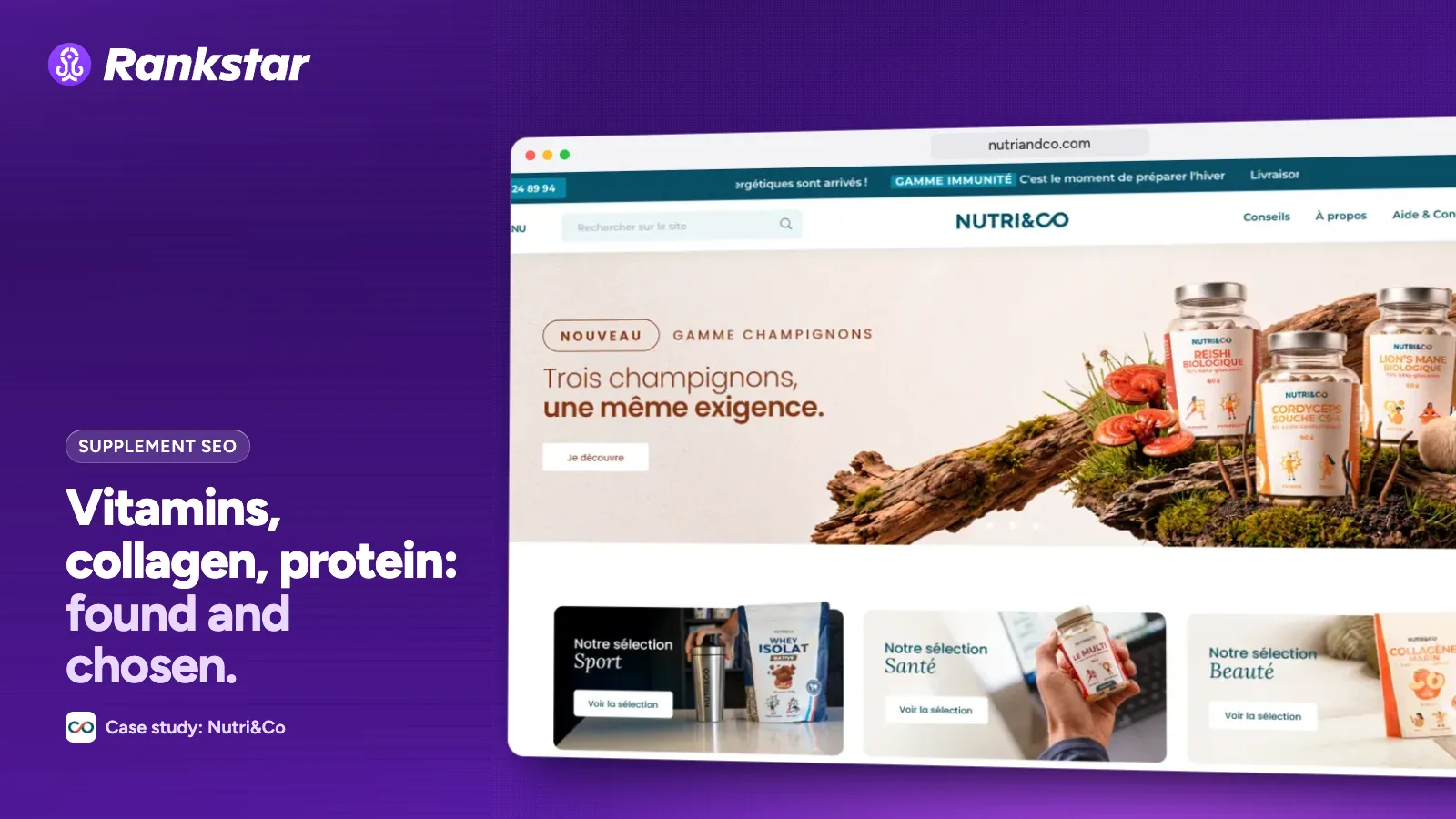
Proof from the field: see how we worked with Nutri&Co in our case study.
What our supplement SEO agency does
Supplement buyers research before they buy. They compare forms ("magnesium glycinate vs citrate"), check dose and testing, then ask an AI assistant which brand to trust. Our SEO for supplement companies covers each step:
- Technical SEO and strategy: a technical audit, keyword research and a topical map in month one, built around your products, your ingredients and the benefits you can substantiate.
- Content: 1,000+ word product, ingredient and comparison pages every month, written by native US, UK or French writers who know a structure/function claim from a disease claim. We write, you publish. See our blog writing service.
- AEO and GEO: citations in the "best of" listicles, reviews and Quora threads that AI answers draw on.
- Google Autosuggest: your brand suggested as people type searches like "[ingredient] supplement" on Google and Bing.
- Links and digital PR: hand-picked placements on health, fitness and food publications.
- Reporting: a monthly dashboard from your own Google Analytics and Search Console.
If you are comparing us with a supplement marketing agency or a health supplement marketing agency, know our scope: we run the search side (SEO, AEO, GEO, Autosuggest, links and PR). We do not run paid ads, email flows or influencer programs.
SEO for supplement companies, product by product
Supplement demand sits at the ingredient and format level, and each category has its own comparison searches and claim traps. This is how we plan the first pages for the categories our clients sell most.
| Category | What buyers search | Pages we build first | Claim to watch |
|---|---|---|---|
| Magnesium | "magnesium glycinate vs citrate", "best magnesium for sleep", "magnesium threonate" | Form comparison pages, one guide per form, dosing FAQs on product pages | "Supports relaxation and restful sleep" is structure/function; "prevents migraines" names a disease. |
| Collagen | "collagen peptides benefits", "marine vs bovine collagen", "collagen for skin" | Source and type pages, skin and joint guides, a sourcing page | Skin and joint benefits need studies that match your dose; nothing about arthritis. |
| Whey and protein powder | "whey isolate vs concentrate", "best protein powder for women", "grass-fed whey" | Isolate and concentrate pages, use-case pages, flavors handled as variants | Protein per serving must match the label; "third-party tested" needs the certificate. |
| Creatine | "creatine monohydrate", "creatine gummies", "creatine for women", "does creatine cause hair loss" | Format pages, a safety guide reviewed by a named expert | Performance claims need research on the same dose and form. |
| NMN and longevity | "NMN vs NR", "NAD+ supplement", "NMN benefits" | Ingredient explainers, comparison pages, a purity page | Keep disease prevention out; anti-aging promises need human trials behind them. |
| Vitamins and multivitamins | "vitamin D3 K2", "best multivitamin for men over 50", "methylated B complex" | Nutrient pages, life-stage pages, a "how we choose doses" page | "Supports normal immune function" works; "prevents the flu" does not. |
| Gummies | "ashwagandha gummies", "sugar-free vitamin gummies", "gummies vs capsules" | Format pages, sugar FAQs, kids' and adult lines kept apart | Same claim rules as capsules; page facts must match the Supplement Facts panel. |
| GLP-1 and weight-loss support | "natural GLP-1 supplement", "Ozempic alternative", "protein on GLP-1" | Nutrition pages for people on a prescribed GLP-1 (protein, fiber), never drug comparison pages | "Alternative to Ozempic" presents the product as a substitute for a drug therapy, which FDA treats as a disease claim. |
Nutri&Co, a French brand selling multivitamins, collagen and whey isolate, ran this plan with us, from technical fixes and a topical map to Autosuggest and AI visibility. Read the Nutri&Co supplement SEO case study. Sports nutrition brands should also see our fitness and sports SEO hub; dietitians with their own range, SEO for nutritionists.
Claim-safe supplement content: FDA, FTC and EU rules (as of November 2026)
Not legal advice. These are the rules our writers work to, so pages reach your regulatory team ready to approve.
FDA: structure/function claims under DSHEA
The Dietary Supplement Health and Education Act (DSHEA) lets a supplement describe how an ingredient affects the normal structure or function of the body ("calcium builds strong bones" is FDA's own example), but not claim to diagnose, treat, cure, mitigate or prevent a disease. FDA does not pre-approve these claims. Under 21 CFR 101.93, the company must notify FDA no later than 30 days after first marketing a product with the claim, and the label must carry this disclaimer, next to the claim or linked to it with an asterisk:
This statement has not been evaluated by the Food and Drug Administration. This product is not intended to diagnose, treat, cure, or prevent any disease.
The rule also finds disease claims in product names, cited studies, images, and in presenting a product as a substitute for a drug therapy.
| We write | We never write |
|---|---|
| "Supports joint comfort" | "Relieves arthritis pain" |
| "Fiber maintains bowel regularity" | "Treats irritable bowel syndrome" |
| "Supports healthy circulation" | "Lowers high blood pressure" |
| "Protein to help you meet your daily intake" | "Works like Ozempic" |
FTC: the Health Products Compliance Guidance
The FTC Health Products Compliance Guidance (December 2022) covers health claims online, in social media and influencer marketing, on packaging and in press releases, so blog posts and product pages count. Three points shape our content:
- Health claims need "competent and reliable scientific evidence," which for most benefit claims means randomized, controlled human clinical trials.
- The research has to fit the product: the FTC asks how your dose and formulation compare to the ones studied.
- Testimonials do not replace evidence, and the DSHEA disclaimer does not fix an otherwise deceptive ad.
Ozempic, semaglutide and GLP-1 searches
Semaglutide, the drug in Ozempic, is a prescription medicine. A product containing it is an unapproved drug, not a supplement, and no supplement can be sold as its replacement. FDA declared the semaglutide shortage resolved on February 21, 2025, and its enforcement discretion for compounders ran out in 2025 (May 22, 2025 for outsourcing facilities). It has also issued warning letters to online sellers of semaglutide labeled "for research purposes." Google Ads bans products that "imply they're as effective as prescription drugs."
So we skip "natural Ozempic" pages and target companion searches: protein, fiber and nutrition for people on a prescribed GLP-1, with no drug comparisons or side-effect claims. Clinics that prescribe these drugs are covered on our telemedicine SEO page and our healthcare SEO agency hub.
Google Ads and EU sales
Google Ads also restricts "herbal and dietary supplements with active pharmaceutical or dangerous ingredients." In the EU, Regulation (EC) No 1924/2006 allows only authorized health claims: EFSA verifies the science, then the European Commission and Member States decide, so EU pages use the authorized wording.
AEO and GEO for supplements: be the brand AI names for "best magnesium"
Shoppers ask ChatGPT, Gemini, Perplexity and Google AI Overviews things like "best magnesium supplement for sleep" or "is NMN worth it." The answers name a few brands and draw on listicles, reviews, forum threads and brand pages. What we do:
- We list the prompts your buyers use in each category and record which brands get named today.
- We place your brand in the "best of" lists and reviews those answers cite, through AI brand mentions, and answer buyer questions with Quora marketing.
- We make product facts easy to quote: form, dose per serving, third-party testing, sourcing and who the product suits, stated the same way on your site, Amazon and retailer listings.
- We add Product and Organization schema so the facts on the page are machine-readable.
Google Autosuggest is where many buyers pick a brand before they see a single result. Autosuggest creation works to get "[your brand] magnesium" or "[your brand] collagen" suggested as people type on Google and Bing. If "[brand] side effects" or "[brand] scam" shows up instead, our online reputation management covers the pages behind it. All of this is part of our SEO, AEO and GEO packages.
Supplement company SEO for your store and for Amazon
Your own store
On Shopify, WooCommerce and custom builds alike, our technical SEO audits turn up the same issues:
- Supplement Facts as text rather than a label image alone, so Google and AI tools can read dose, servings and ingredients.
- Variants under one URL: flavors, sizes and counts as options on one indexable page, so reviews and links are not split.
- Collection pages by goal, form and diet (vegan, sugar-free), with thin filter combinations kept out of the index.
- Trust signals: certificates of analysis, testing partners, manufacturing details and named authors and reviewers with real bios.
Google calls topics that can affect "the health, financial stability, or safety of people" Your Money or Your Life (YMYL), says "trust is most important," and recommends bylines "where readers might expect it." More on store builds in our Shopify SEO guide and our ecommerce SEO agency hub.
Amazon
Many supplement buyers shop on Amazon, and its listings often appear on Google for product searches. Our Amazon SEO, AEO and GEO packages cover your marketplace listings, written to the same claim rules as your site. Your site then targets the research searches where Amazon product pages tend not to rank: comparisons, "how to choose" guides and ingredient explainers.
Link building and digital PR for supplement brands
Health publishers link to brands that give them something to cite: original data, expert comment, clear sourcing. Google's spam policies list "sending someone a product in exchange for them writing about it and including a link" as link spam, unless the link carries rel="sponsored" or rel="nofollow". That covers the common supplement habit of sending free tubs to bloggers for a review with a followed link.
- Supplement link building: editorial links from health, fitness, food and lifestyle sites, checked for real traffic and topic fit.
- Digital PR: surveys, sourcing stories and comment from your dietitians or formulators, pitched to health and wellness journalists.
- Guest posts and niche edits on nutrition and training blogs.
- International link building for brands that sell in the US, UK and EU.
How our supplement SEO services run, month by month
- A 5-minute brief after checkout: products, markets, the claims you hold substantiation for and who signs off content.
- Month one: technical audit, keyword research and a topical map covering product, ingredient, comparison and guide pages.
- Every month: new content, off-site placements (PR, guest posts, niche edits, AI citations, Quora answers) and Autosuggest keywords, delivered within 28 days, or 14 with express delivery.
- Reporting: the dashboard updates monthly; agencies get white-label reports.
Plans for supplement and nutrition brands
Monthly SEO, AEO and GEO run by a dedicated consultant, with every page written to the claims you can substantiate.
-
Launch
- 1 × Technical audit
- 1 × Keyword research
- 1 × Topical map
- On-site SEO / AEO / GEO
- 10 focus SEO / AEO / GEO keywords
- 2 × HQ content (1,000+ words)
1 off-site placement
- 1 × HQ link
- White-label report
- Tracking dashboard, updated monthly
- Dedicated consultant
-
🔥 Popular
Essential
- 1 × Technical audit
- 1 × Keyword research
- 1 × Topical map
- On-site SEO / AEO / GEO
- 20 focus SEO / AEO / GEO keywords
- 5 × HQ content (1,000+ words)
2 off-site placements
- 1 × HQ link
- 1 × AI citation (listicle)
- 1 × Autosuggest keyword
- White-label report
- Tracking dashboard, updated monthly
- Dedicated consultant
-
Growth
- 1 × Technical audit
- 1 × Keyword research
- 1 × Topical map
- On-site SEO / AEO / GEO
- 50 focus SEO / AEO / GEO keywords
- 10 × HQ content (1,000+ words)
4 off-site placements
- 2 × HQ links
- 1 × AI citation (listicle)
- 1 × AI citation (review)
- 2 × Autosuggest keywords
- White-label report
- Tracking dashboard, updated monthly
- Dedicated consultant
-
Pro
- 1 × Technical audit
- 1 × Keyword research
- 1 × Topical map
- On-site SEO / AEO / GEO
- 150 focus SEO / AEO / GEO keywords
- 20 × HQ content (1,000+ words)
7 off-site placements
- 3 × HQ links
- 2 × AI citations (listicle)
- 2 × AI citations (review)
- 8 × Autosuggest keywords
- Google AI Overviews secret sauce
- White-label report
- Tracking dashboard, updated monthly
- Dedicated consultant
-
Authority
- 1 × Technical audit
- 1 × Keyword research
- 1 × Topical map
- On-site SEO / AEO / GEO
- 250 focus SEO / AEO / GEO keywords
- 30 × HQ content (1,000+ words)
20 off-site placements
- 4 × HQ links
- 3 × AI citations (listicle)
- 3 × AI citations (review)
- 10 × Quora answers
- 10 × Autosuggest keywords
- Google AI Overviews secret sauce
- White-label report
- Tracking dashboard, updated monthly
- Dedicated consultant
How to vet a supplement SEO company, and mistakes to avoid
Questions to ask
- Can I see a live supplement case study I can check myself?
- How do your writers handle structure/function wording, the DSHEA disclaimer and FTC substantiation, and who reviews health content?
- Where do your links come from, and are any of them paid or product-for-review placements?
- Do you track AI answers and Autosuggest as well as rankings?
Walk away from anyone promising page-one rankings or offering "Ozempic alternative" pages.
Common mistakes on supplement sites
- Condition pages that slide into disease claims ("magnesium for anxiety disorder").
- One URL per flavor and size, splitting reviews and links.
- Health content with no named author or reviewer.
Ingredient suppliers and contract manufacturers that sell to brands follow a B2B playbook; see SEO for pharmaceutical and biotech firms.
Supplement SEO: FAQ
What does a supplement SEO agency do?
It gets supplement brands found on Google and in AI answers for the products and ingredients they sell. At Rankstar that means technical fixes, keyword research, claim-safe content, links and PR, plus AI citations and Google Autosuggest, run by one consultant.
How long does SEO take for a supplement brand?
Each month's deliverables arrive within 28 days, or 14 with express delivery. Most of our clients see more AI and search visitors in their first month. Broad terms like "best protein powder" take longer, because supplements are a YMYL topic and authority builds with each month of content and links.
Can a supplement brand outrank Amazon on Google?
Yes, on research searches such as comparisons, ingredient guides and "how to choose" questions, where Amazon product pages tend not to rank. For product searches, most brands do best on both fronts, with their own site and with Amazon SEO, AEO and GEO for their listings.
Can you write about health conditions without making disease claims?
Yes. We write about how ingredients support normal body functions, cite research that fits your dose, and keep disease names out of product pages and product names. Condition-level education goes in clearly separate articles, reviewed by your team before it goes live.
Why is SEO important for supplement companies?
Supplement buyers research ingredients, forms and brands before they buy, on Google and in AI assistants. Google Ads restricts supplements with active pharmaceutical ingredients and any product implied to work like a prescription drug, so organic rankings and AI citations are channels every compliant brand can build.
Are you a supplement marketing agency?
We cover the search side of supplement marketing: SEO, AEO, GEO, Google Autosuggest, digital PR and link building. We do not run paid ads, email or influencer programs. See our SEO, AEO and GEO packages for what each plan includes.








Get your supplement brand found on Google, Amazon and in AI answers
Tell us your products, markets and the claims you can back in a 5-minute brief. Your consultant starts with a technical audit, keyword research and a topical map, then delivers claim-safe content, placements and Autosuggest every month.