On this page
- Why SaaS SEO is its own discipline
- The pages that turn searches into signups
- What our SaaS SEO services include
- Docs, help center and trust pages: the SEO assets most SaaS teams ignore
- SaaS AEO and GEO: getting recommended by AI assistants
- SaaS SEO for your growth model and category
- How we work with SaaS teams
- How to choose a SaaS SEO agency
- SaaS SEO mistakes we fix most often
- SaaS SEO agency: FAQ
Rankstar is a SaaS SEO agency for software, AI and IT companies that want more trials, demos and signups from search. We help your site rank for the feature, comparison, integration and "alternatives" searches buyers run before they choose a tool, and help your product get named when they ask ChatGPT, Gemini, Perplexity or Google AI Overviews which software to use, with a dedicated consultant and a monthly dashboard from your own Analytics and Search Console: see the plans or book a call.
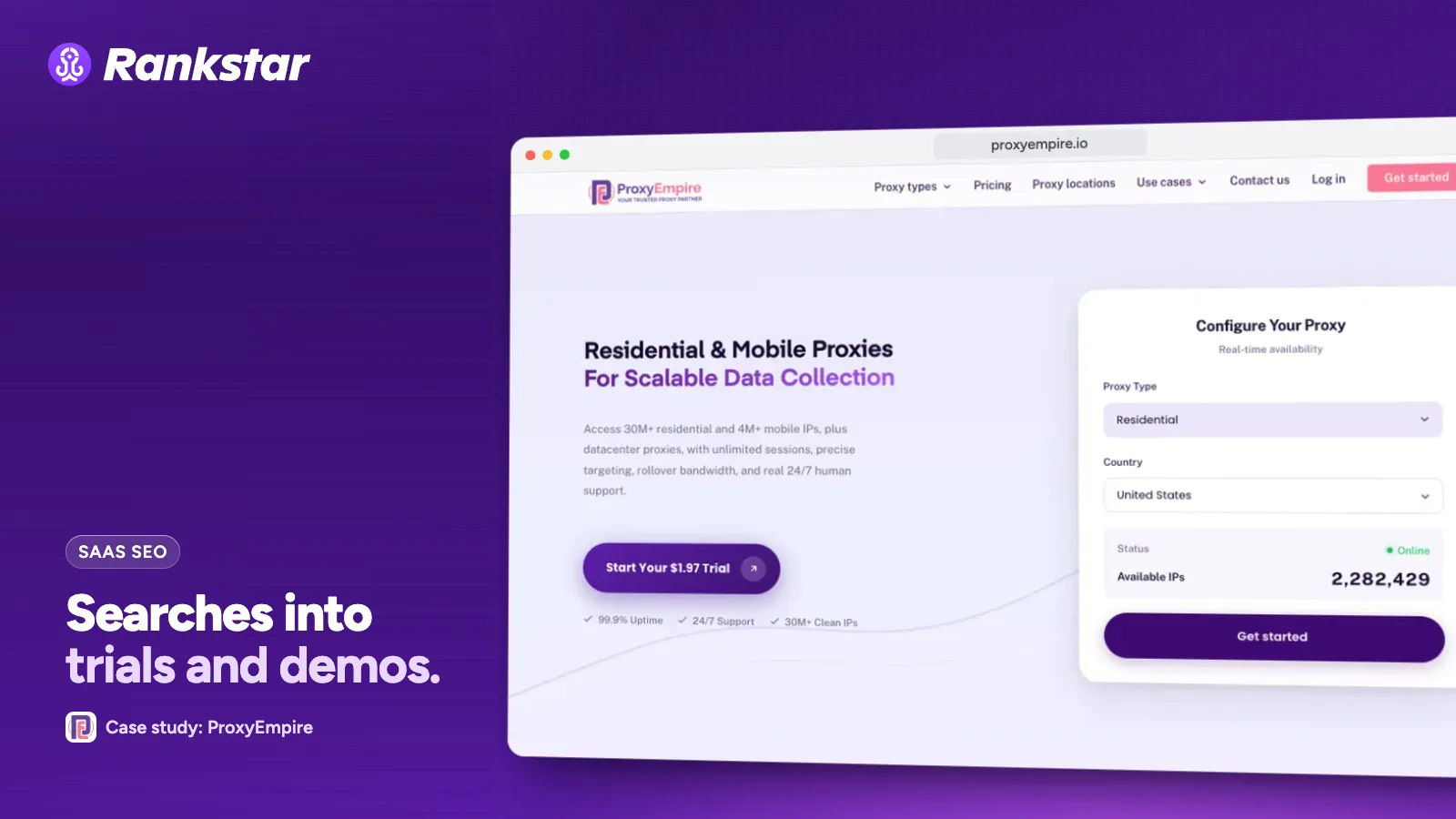
Proof from the field: see how we worked with ProxyEmpire in our case study.
Why SaaS SEO is its own discipline
- The conversion is a trial, a demo or a signup, not a purchase. Content has to move readers into the product, and success is measured in signups, product-qualified leads, pipeline and MRR, not sessions.
- Buyers compare before they talk to you. Software buyers search "best [category] software", "[competitor] alternatives" and "[tool A] vs [tool B]". Whoever owns those pages frames the decision.
- Review sites and AI answers sit between you and the buyer. G2, Capterra, TrustRadius and AI assistants often rank above vendor sites for category searches.
- The product changes every month. New features, integrations and pricing changes leave old pages wrong.
- The site is often a JavaScript app. Marketing sites built on React, Next.js or a headless CMS, docs on a subdomain and an app behind a login create technical problems most SEO checklists miss.
- Keyword volumes are small and intent is high. "SOC 2 compliance automation software" has a fraction of the searches of "compliance", and nearly every one of them comes from a potential buyer.
The pages that turn searches into signups
A SaaS SEO strategy is mostly a page strategy. These page types drive signups for most software companies:
| Page type | Search intent | Example query |
|---|---|---|
| Feature pages | Solution-aware, checking capability | "invoice approval workflow software" |
| Use case and industry pages | Problem-aware, looking for a fit | "project management for construction teams" |
| Integration pages | Checking compatibility with their stack | "[CRM] integration with Slack" |
| Comparison pages | Shortlist, deciding between two tools | "[your brand] vs [competitor]" |
| Alternatives pages | Unhappy with a current tool | "[competitor] alternatives" |
| Pricing page | Late stage, checking cost and plans | "[brand] pricing" |
| Templates, calculators, free tools | Early stage, high volume, product-adjacent | "OKR template", "SaaS churn calculator" |
| Guides and glossary | Learning the category | "what is revenue operations" |
| Docs and help center | Evaluating or already using the product | "[brand] API webhooks" |
We build feature, comparison, alternatives and integration pages first because they convert, then guides and templates to widen the audience. Comparison and alternatives pages work when they are honest: who each tool suits, a clear feature table, and where a competitor is stronger.
Where a page type repeats across hundreds of integrations or use cases, we plan a programmatic SEO template with enough unique content per page to be worth indexing.
What our SaaS SEO services include
Every SEO, AEO and GEO package is run by one consultant who learns your product and ICP.
Technical SEO for software sites
Month 1 brings a full technical audit: rendering, indexing, canonical tags, subdomain and subfolder setup for the blog and docs, staging or app URLs leaking into the index, duplicate pages from UTM and filter parameters, internal linking between marketing pages and docs, and Core Web Vitals. Google's JavaScript SEO documentation explains that Google renders JavaScript in a queue and still recommends server-side rendering or pre-rendering, partly because not every crawler runs JavaScript. That includes many AI crawlers, so content that only appears after scripts run may be invisible to the systems writing AI answers.
Keyword research built on your ICP
We start from the jobs your customers hire the product for, the pain points in your sales calls and the tools they replace, then map the searches behind each one. The result is a topical map of every page you need, by funnel stage.
Product-led content
Each month our native US, UK or French writers deliver 1,000+ word pieces: feature and use case pages, comparisons, alternatives pages, guides and blog posts that show the product solving the problem, with real workflows rather than generic advice. We write, your team reviews for product accuracy and publishes.
Content maintenance as the product changes
Every release can make a page wrong: a renamed feature, a new integration, a changed plan. Outdated pages lose rankings and confuse AI answers that quote them. We refresh affected pages after launches and update comparisons when competitors change.
Links and digital PR
Software sites earn authority from tech publications, partner and integration pages, podcasts, SaaS roundups and original data. We secure hand-picked placements through digital PR, guest posts and niche edits on relevant sites. Anonymized product-usage data makes strong link bait.
Conversion from page to trial
We review calls to action, demo and signup paths, and the content that sits next to the decision: pricing clarity, security answers, integration lists. For deeper testing, see conversion rate optimization.
Ready to start? Compare the plans or talk to a consultant.
Docs, help center and trust pages: the SEO assets most SaaS teams ignore
Your documentation often answers more specific questions than your marketing site, and buyers read it during evaluation. Developers search error messages and API endpoints; admins search "how to set up SSO in [tool]". Indexable docs win long-tail searches and prove what the sales page claims.
- Make docs indexable and fast. Many docs platforms render client-side or sit on a subdomain with no links from the main site. We check both.
- Turn integration docs into integration pages. A setup guide answers users. A matching integration page answers buyers searching "[tool] + [your category]".
- Keep the changelog public and dated. It shows active development, gives AI systems current facts, and supports "does [tool] have [feature]" searches.
- Publish your trust facts. Buyers search "HIPAA compliant [category] software", "GDPR compliant [category]" and "SOC 2 [category] tool". A security page that states what you actually hold (a SOC 2 report, a signed BAA, data residency options) ranks for those searches and shortens security reviews. Only state what is current and verified.
- Mark up the product. Google documents SoftwareApplication structured data for showing app details such as ratings and price in search results. We add it where it fits, alongside Organization and FAQ markup.
SaaS AEO and GEO: getting recommended by AI assistants
AEO and GEO help your product get cited in AI answers. For software, the most valuable AI prompt is a shortlist request: "What is the best help desk software for a 20-person team?"
Google states that the same SEO fundamentals apply to AI Overviews and AI Mode, with no extra technical requirements beyond being indexed and eligible for a snippet. For software, the cited sources are predictable:
- "Best of" listicles and roundups. Our AI brand mentions work places your product in the articles AI systems cite for your category.
- Review platforms. A complete, current G2 or Capterra profile with recent reviews feeds both Google results and AI answers.
- Marketplace and app store listings. Salesforce AppExchange, the HubSpot App Marketplace, the Atlassian Marketplace and the Shopify App Store rank for integration searches and are read by buyers and AI systems.
- Quora and community answers on the questions buyers ask before choosing a tool, written by people who know the category.
- Your own comparison and alternatives pages, written fairly enough that an assistant can quote them.
- Consistent product facts across your site, docs, marketplace listings and review profiles: the same category, features, integrations and pricing model.
Google Autosuggest for software brands
Before anyone sees a result, Google and Bing suggest searches as they type. When a buyer types "help desk software for" or "[competitor] alternatives" and your brand appears in the suggestions, you enter the comparison on your terms. From the Essential plan up, our Autosuggest keywords service helps get your brand suggested for category and alternatives searches, and the dashboard reports the traffic it sends.
SaaS SEO for your growth model and category
Product-led and freemium SaaS
Self-serve products need volume at the top and frictionless signup at the bottom. Templates, free tools and use case pages feed signups, and in-product prompts turn them into activated users.
Sales-led and enterprise SaaS
Enterprise SaaS SEO targets fewer, more expensive searches made by buying committees: security, compliance, integrations, migration and total cost questions. Large sites with many products, languages or thousands of docs pages fit our enterprise SEO packages. If you sell services rather than software to businesses, our B2B SEO agency page covers that playbook.
Vertical SaaS
Software built for one industry (construction, dental practices, law firms, logistics) wins with that industry's vocabulary, not software jargon. Buyers search "scheduling software for HVAC contractors", not "field service management platform".
Developer tools and APIs
Developers skip marketing copy and search code: SDK names, error messages, "how to" queries with a language attached. Docs quality, code samples and technical tutorials drive this kind of SaaS SEO.
AI products
New AI categories often have no settled name yet, so part of the work is choosing the terms buyers will use and publishing the definitive page for each. See our notes on SEO for AI and machine learning companies.
IT services, MSPs and cybersecurity
Managed service providers and security firms sell trust as much as technology, and many sell within a region. Service-area pages, certification pages and incident-response content matter here. More in SEO for cybersecurity and IT services.
Early-stage and pre-product-market-fit? Our startup SEO page covers what to do before you have a full funnel.
How we work with SaaS teams
- 5-minute brief after checkout: product, ICP, main competitors, growth model and the metrics you report on.
- Month 1: technical audit, keyword research and a topical map with the page plan in priority order.
- Every month: new 1,000+ word content for you to publish, plus off-site placements: PR, guest posts, niche edits, AI citations in listicles and reviews, and Quora answers.
- Delivery within 28 days each month, or 14 days with express delivery, so content lines up with launches.
- A dashboard updated monthly with rankings, AI visitors and Autosuggest traffic from your own Google Analytics and Search Console.
What we need from your team
Analytics and Search Console access, a PM or product marketer to check facts, someone to publish, and notice before launches.
SaaS SEO metrics that finance will accept
We report on the numbers that connect to revenue: organic and AI-referred signups, trials and demo requests by landing page, and the share of those that become qualified pipeline. Set up conversion events in GA4 and pass the source into your CRM, and you can show SEO's effect on CAC and pipeline, not just on traffic.
Timing
Fixes to existing pages and comparison or integration pages for low-competition terms tend to move first. Category terms against established competitors take longer. Judge the program over several quarters.
Plans for SaaS and tech companies
Monthly SEO, AEO and GEO with a dedicated consultant, planned around your product, your ICP and your signup funnel.
-
Launch
- 1 × Technical audit
- 1 × Keyword research
- 1 × Topical map
- On-site SEO / AEO / GEO
- 10 focus SEO / AEO / GEO keywords
- 2 × HQ content (1,000+ words)
1 off-site placement
- 1 × HQ link
- White-label report
- Tracking dashboard, updated monthly
- Dedicated consultant
-
🔥 Popular
Essential
- 1 × Technical audit
- 1 × Keyword research
- 1 × Topical map
- On-site SEO / AEO / GEO
- 20 focus SEO / AEO / GEO keywords
- 5 × HQ content (1,000+ words)
2 off-site placements
- 1 × HQ link
- 1 × AI citation (listicle)
- 1 × Autosuggest keyword
- White-label report
- Tracking dashboard, updated monthly
- Dedicated consultant
-
Growth
- 1 × Technical audit
- 1 × Keyword research
- 1 × Topical map
- On-site SEO / AEO / GEO
- 50 focus SEO / AEO / GEO keywords
- 10 × HQ content (1,000+ words)
4 off-site placements
- 2 × HQ links
- 1 × AI citation (listicle)
- 1 × AI citation (review)
- 2 × Autosuggest keywords
- White-label report
- Tracking dashboard, updated monthly
- Dedicated consultant
-
Pro
- 1 × Technical audit
- 1 × Keyword research
- 1 × Topical map
- On-site SEO / AEO / GEO
- 150 focus SEO / AEO / GEO keywords
- 20 × HQ content (1,000+ words)
7 off-site placements
- 3 × HQ links
- 2 × AI citations (listicle)
- 2 × AI citations (review)
- 8 × Autosuggest keywords
- Google AI Overviews secret sauce
- White-label report
- Tracking dashboard, updated monthly
- Dedicated consultant
-
Authority
- 1 × Technical audit
- 1 × Keyword research
- 1 × Topical map
- On-site SEO / AEO / GEO
- 250 focus SEO / AEO / GEO keywords
- 30 × HQ content (1,000+ words)
20 off-site placements
- 4 × HQ links
- 3 × AI citations (listicle)
- 3 × AI citations (review)
- 10 × Quora answers
- 10 × Autosuggest keywords
- Google AI Overviews secret sauce
- White-label report
- Tracking dashboard, updated monthly
- Dedicated consultant
How to choose a SaaS SEO agency
- Do they start from your ICP and funnel, or from keyword volume? Ask what pages they would build first and why.
- Can they write about your product? Ask for a sample comparison or feature page in a category as technical as yours.
- Do they handle JavaScript sites and docs? Ask how they check rendering and indexing.
- What is their AI search plan? They should name the sources they will work on: listicles, review sites, Quora, your own pages.
- How do they report? Signups, trials and demos by page, from your own data.
Red flags: traffic promises with no conversion plan, links from sites with no relation to software, and a blog-only plan that never touches feature, comparison or pricing pages.
SaaS SEO mistakes we fix most often
- A blog with no bottom of funnel. Hundreds of top-of-funnel posts and no feature, comparison, alternatives or integration pages.
- Content that never mentions the product. Generic guides attract readers who have no reason to sign up. Show the workflow inside your tool.
- Leaving comparisons to competitors. If you have no "vs" page, a competitor's version ranks for your brand name.
- Pricing pages with nothing to index. A pricing table rendered by script, with no text about what each plan includes, loses "[brand] pricing" searches to review sites.
- Reporting traffic instead of signups. Without conversion tracking by landing page, SEO looks like a cost center at budget time.
SaaS SEO agency: FAQ
What does a SaaS SEO agency do?
A SaaS SEO agency helps software companies win trials, demos and signups from search. That covers technical SEO for JavaScript sites and docs, keyword research built on your ICP, feature, comparison and integration pages, links and PR, and, increasingly, getting your product cited in AI answers.
How is SaaS SEO different from regular SEO?
SaaS SEO measures success in signups, trials and pipeline instead of sales or traffic, targets comparison and alternatives searches, deals with review sites and AI assistants that rank above vendors, and keeps content updated as the product changes. Technical work often involves JavaScript rendering and docs subdomains.
How long does SEO take for a SaaS company?
Improvements to existing pages and low-competition comparison or integration pages tend to show first, while broad category terms against established competitors take longer. Most SaaS teams should judge SEO over several quarters, with monthly reporting on signups and demos by landing page.
Should a SaaS company publish competitor comparison pages?
Yes, if they are fair and accurate. Buyers search "[tool A] vs [tool B]" and "[competitor] alternatives" right before they decide. If you do not publish those pages, a competitor or review site frames the comparison for you. Keep claims factual and update them as products change.
Do you work with enterprise SaaS companies?
Yes. Enterprise SaaS sites with several products, languages or large documentation libraries are covered by our enterprise SEO packages, built on the same SEO, AEO and GEO work with the scale those sites need.
How do you get a software product recommended by ChatGPT?
We make your own pages answer buyer questions clearly, keep product facts consistent across your site, docs and review profiles, and earn mentions in the listicles and roundups AI assistants cite. Our AI brand mentions service places your product in those sources.
Can SEO lower our customer acquisition cost?
It can help. Organic and AI-referred signups do not carry a cost per click, and pages keep working after they are published. The effect on CAC shows when conversions are tracked by landing page and passed into your CRM, which is how we set up reporting.
Do you only work with B2B SaaS?
No. We work with B2B SaaS, consumer apps, developer tools, AI products, hosting providers and IT services firms. The page types and channels change by model, so the topical map is built for your product. Early-stage teams can start with our startup SEO approach.








Get your product on the shortlist
Win the comparison searches, the AI recommendations and the Autosuggest dropdown before buyers book a demo with someone else. Pick a plan, send a 5-minute brief, and your consultant starts with an audit and a page plan.