On this page
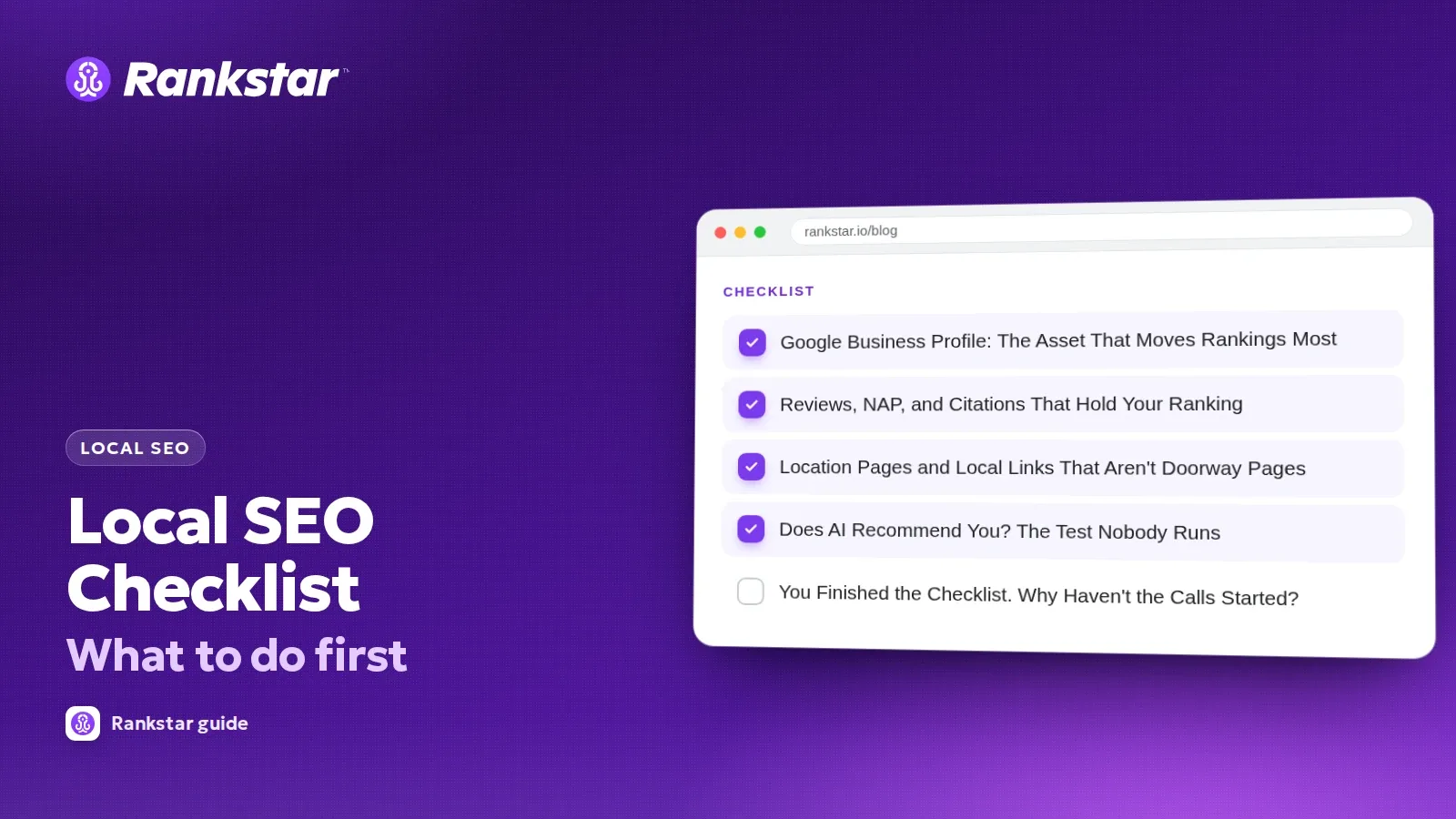
- The 2027 Local SEO Checklist at a Glance
- Google Business Profile: The Asset That Moves Rankings Most
- Reviews, NAP, and Citations That Hold Your Ranking
- Location Pages and Local Links That Aren't Doorway Pages
- Does AI Recommend You? The Test Nobody Runs
- You Finished the Checklist. Why Haven't the Calls Started?
- Your Map Pack Ranking Is a Monthly Habit
- FAQ
- Sources
Most local SEO checklists assume you haven't started. This one assumes you have: profile claimed, reviews in, citations clean, and the phone still quiet. Google ranks local results on relevance, distance, and prominence, per Google Business Profile Help, so every step in this local SEO checklist for 2027 feeds one of the three. Our location SEO guides cover the map side; the local SEO strategies behind them explain the why.
TL;DR — Local rankings still come down to relevance, distance, and prominence. In 2027 that means a fully built Google Business Profile first, then reviews, clean citations, and one real page per location. Everything else is secondary.
The 2027 Local SEO Checklist at a Glance
A local SEO checklist is the set of tasks that decide whether your business shows up when someone nearby searches for what you sell. Five parts, one fixed order: profile, reviews, citations, location pages, links. Run them out of sequence and you spend weeks on links that a half-built profile can't convert.
| Task | Who owns it | Cadence |
|---|---|---|
| Profile fields, photos, posts | Owner or marketer | Monthly |
| Review requests and replies | Front desk | Weekly |
| NAP and citation audit | Marketer | Quarterly |
| Location page refresh | Writer | Quarterly |
| Rank, call and form tracking | Marketer | Monthly |
If you only have five hours this month, do these five things first. It's the order we use on local SEO projects.
- Fix the primary category. 15 minutes. The most specific one that matches your core service, plus secondary categories.
- Describe every service. 45 minutes. Google matches long-tail searches against these fields.
- Ask your last 20 customers for a review. 60 minutes. One message, direct link, no incentive.
- Reply to every unanswered review. 30 minutes. Buyers read your replies, not just Google.
- Rewrite one location page. 2 hours. Real address, hours, staff, photos, directions.
Get a free local SEO strategy call
Google Business Profile: The Asset That Moves Rankings Most
Your Business Profile feeds relevance, distance and prominence at once, which makes it the highest-value item here. It's also the one Google polices hardest.
Start with the name. It must match your real-world business name, with no added keywords or city, because Google's representation guidelines treat stuffed names as grounds for suspension. The primary category is the strongest relevance signal on the profile, so pick the most specific one that fits.
The fields most owners skip:
- Video verification. Have signage, a vehicle and your workspace ready to film before you start.
- Services with descriptions. Each one is a matching signal for searches like "emergency root canal".
- The description field. Say what you do, who for, and where. Skip promotional language.
- Real photos, refreshed monthly. Exterior, interior, team, finished work.
- Seeded Q&A. Post your ten most common questions and answer them yourself.
A suspension pulls your reviews, photos and posts off Maps, and reinstatement can take weeks. It's the most expensive mistake on this list, and the easiest to avoid.
Reviews, NAP, and Citations That Hold Your Ranking
Reviews do double duty in 2027. They rank you in the map pack, and they're what AI assistants quote when someone asks for a recommendation. Ask at the moment the job finishes, when goodwill peaks, and reply to every review, positive or negative.
Compliance matters more than most owners realize. The FTC's rule on consumer reviews and testimonials bans fake reviews, bought reviews and incentives conditioned on a positive rating, with civil penalties attached.
NAP consistency is the boring half of the same job. Your name, address and phone must match character for character on Google, Apple Business Connect, Bing Places, Yelp and your industry directories. After a move or rebrand, old addresses linger on data aggregators for months, so audit quarterly and merge duplicates before they split your citations.
Location Pages and Local Links That Aren't Doorway Pages
One page per location, with content that could only describe that location: address, hours, directions, the services offered there, local photos, an embedded map. Swap the city name on a template and you've built a doorway page, the failure every audit finds.
Service-area businesses follow the same rule without a storefront. Hide the address in your profile, set your service areas, then build a page per main area with projects completed there, typical response times and reviews from customers in that town.
Mark each page up with LocalBusiness structured data so search engines read the address, hours and coordinates directly. Google's structured data guide lists the required fields, and the LocalBusiness vocabulary defines the rest.
Links come last, and they're how local SEO authority compounds. Sponsor a local event, join the chamber, pitch the local paper, partner with a nearby business that serves the same customers. Judge each one by whether a real local audience sees it. A sponsorship page on a rugby club site beats a directory listing nobody reads.
See how we build local visibility
Does AI Recommend You? The Test Nobody Runs
AI answers are now part of local discovery, and almost nobody checks whether they appear in them. The test takes five minutes a month.
Open ChatGPT, Gemini, Google's AI Mode and Perplexity, then run two prompts: "best [your service] in [your city]" and "who should I call for [your service] near [your city]". Log four things: whether you appear, which competitors do, which page gets cited, and what the answer says about you.
Fix what the log shows. Assistants pull from review language, service pages and directory listings, so reviews naming the specific job ("replaced our furnace in one day") beat generic praise. Pages listing prices, areas served and clear services get quoted more often than pages that only describe the company. Keep the log in one sheet: date, prompt, whether you appeared, which competitors showed up, and which page got cited. Two months of entries show trends a single check never will.
You Finished the Checklist. Why Haven't the Calls Started?
The plateau has three causes: priority, proximity, and proof.
Priority is where most checklists fail. The five-hour list above exists because profile completeness moves rankings faster than anything else on this page.
Proof is the reporting layer. If you can't say which calls came from local search, you can't defend the budget. Put a call tracking number on your profile, tag your website links, then report monthly by source: calls, forms, direction requests, booked jobs.
If your agency reports rankings but not calls and booked jobs, you're paying for a scoreboard nobody buys from.
That's also the honest test for hiring. Ask any provider those three questions before you sign. If you'd rather keep it in-house, professional SEO services make sense once the work passes about ten hours a month and the reporting gets complicated.
Your Map Pack Ranking Is a Monthly Habit
FAQ
What matters most for local SEO in 2027?
Your Google Business Profile carries the most weight, because it feeds relevance, distance and prominence at once. For a single-location business, an hour on the profile usually beats an hour on the website.
How many reviews do I need?
Google publishes no review threshold. Recency and reply rate count as much as volume, so thirty reviews from the past year with replies beat a backlog of old ones with none.
Do I need a page for every city I serve?
No. Build pages only for areas where you complete regular work and can write something specific. Twenty thin city pages dilute the site and read as doorway pages.
How long does local SEO take to show results?
Plan on a few months of consistent work before the map pack moves, and longer in competitive markets. Rankings respond to the whole checklist rather than any single item, so run the tasks in order and let reviews, citations and pages accumulate. Treat it as a monthly habit, not a one-off project, and the gains tend to hold.